Showing posts with label Events. Show all posts

Monday, October 25, 2021

ConFABulous 2021 Program Schedule


ConFABulous 2021 is a free virtual gaming convention for LGBTQ+ people and their friends is scheduled for Saturday, November 6 (with some gaming events also scheduled for Sunday, 11/7). 

ConFABulous will have one high quality programming track on 11/6, with panelists participating via Zoom, and broadcast on the convention's YouTube panel. 

RPGs will happen on 11/6 and 11/7 via the ConFABulous Discord server.

See a panel you'd like to be on? See a game you'd like to play? The first step is to register for the convention. You sign up at ConFABulous.org. Then email confabulous.info@gmail.com if you want to be panelist or sign up for a game.

The convention website will be updated in about a week with the final schedule of programming and games, but in the meantime, here is the full schedule as it stands today:


Panels - Saturday, November 6

  • 10-11 AM - What Have You Read Over the Last Year? The North Country Gaylaxians Book Club has continued to read an LGBTQ+ SF/F book every month, and we know that a lot of people have stepped up their reading and participation in virtual book clubs. What have you read, and was it good?
  • 11:30-12:30 - Media Tie-Ins with Games: Catherine Lundoff writes media tie-ins for games, among other things, and specifically for Onyx Path Publishing’s World of Darkness series. She's written stories for the 20th Anniversary Edition of Vampire the Masquerade and the 20th Anniversary Edition of Wraith, and as of today, a story that became a game scenario for Ghost Hunters. She is eager to discuss media tie-ins and horror game writing.
  • 1:30-2:30 PM - Hot Robin Covers - and Loki - Exploring the New LGBTQ Characters in Mainstream Comics and TV series based on the comics. What's queer, what's not so queer, and what's good?
  • 3-4 PM - How did you get your gaming fix during the pandemic? What worked and what didn’t? What are you going to keep doing that you started in the pandemic? What games were you excited about this year? What games worked well this year and which ones didn't?
  • 4:30-5:30 PM - What’s queer and good in new TV series? Includes Picard (second season), Lord of the Rings, Wheel of Time, Foundation Trilogy, Black Widow, Legends of Tomorrow, Killjoys, Batwoman, etc.!
  • 7-8 PM - Ask A DM: Level-Up Time! Our ever-popular panel in which people talk about their experiences as dungeonmasters/gamemasters, and answer people’s questions about how to offer engaging and effective roleplaying experiences.
  • 8:30-9:30 PM - An Expanded Universe After All: How Is the Star Wars Universe Changing With All the New TV Series, Movies, and Comics?


Gaming - Saturday, 11/6 and Sunday, 11/7

  • Saturday, 11/6, 1-3 PM - Troika! RPG: Adventure across the humpbacked sky! Troika is a complete yet wildly-open RPG. Players can expect to fly through mystic space, get lost in infinite cities of the gods, and meet strange & wonderful people all the while using a robust and familiar game system. We will be playing Micah Anderson's "Carnelian Riddle in the House of Indolent Blooms", an entry to the Troika! Pamphlet Adventure Jam, in which you are commissioned to rob a sphinx, infiltrating his garden party, meandering through a semi-hostile demiplane segregated from the flow of time. Up to 5 players. GM is James Bacigalupo.
  • Saturday, 11/6, 8- 11 PM - Thirsty Sword Lesbians RPG: "The Coffeehouse on the Edge" - You play a lesbian with a sword - and feelings and desires. You have a coffeehouse on the edge of fairyland to defend against gentrificaiton in this slice-of-life adventure in a world with magic, swordplay, romance, and creeping (creepy?) capitalism. Rules are easy to learn. Up to 5 players. GM is John Till.
  • Sunday, 11/7, 9 AM-12 Noon - MÖRK BORG RPG: A DOOM METAL ALBUM OF A GAME. A SPIKED FLAIL TO THE FACE. LIGHT ON RULES, HEAVY EVERYTHING ELSE. Up to 5 players. GM is James Bacigalupo.
  • Sunday, 11/7, 1-4 PM - Everway-Silver Anniversary Edition RPG : "The Quest for the Queer Sphere" - You play Spherewalkers with the ability to use gates to walk between worlds in this multicultural, mythic, high fantasy RPG. Out now in a new edition via Kickstarter, Everway uses a Tarot-like Fortune Deck to determine the results of character actions. The focus is on narrative and story. Rules are easy to learn. Up to 5 players. GM is John Till.


Wednesday, September 1, 2021

My Games At Gamehole Con 2021


I have four games planned for the virtual game track at Gamehole Con 2021, October 21-24, 2021. To sign up for these events, you need to register to attend Gamehole Con here. Once you have done that, you can select events. Events opened for sign up today!

Here are my events, and a convenient link on the Gamehole Con page to all the events that I am running:

Tekumel: Prince of Barsoom, Thursday, October 21, 1-4 PM CT: A new emperor sits on the Petal Throne and has charged you with hunting down a rebel Prince who has escaped through an interdimensional Nexus Point. Find the Nexus Point and follow the rebel Prince to Barsoom, the fabled Red Planet of of John Carter and Dejah Thoris. Swords & Planet adventure on two worlds! The Worlds of Tekumel and Barsoom involve adult themes including slavery and sexuality. While these themes are not the focus of the game session, players should be aware of this before signing up for this game session. Game will be run on the convention Discord server. This game uses the John Carter of Mars RPG (2d20 System) from Modiphius.

Tekumel: Over the Wall, Friday, October 22, 3-6 PM CT: Your clanhouse shares a wall with another. There has been no sign of activity next door in an entire day, which is extremely odd. Relations with the other clan are strained, as they have a history of not paying their fair share in wall repairs. The elders also suspect that the neighbors have tunneled under the walls of your clanhouse at some point. Considering the odd lack-of-activity next door, your clan elders authorize a little expedition over the wall, to find out what has been going on. The World of Tekumel involves adult themes including slavery and sexuality. While these aren't a focus of the game session, players should be aware of this before signing up for this game session. Game will be run on the convention Discord server. Fate of Tekumel RPG system.

Everway: the Great Return, Saturday, October 23, 6 PM-10 PM: More than 25 years ago, Wizards published an RPG with three booklets in a white box. Everway reinvented fantasy gaming, taking things to a mythic level in which you play Spherewalkers exploring the Multiverse. Characters were created using Vision Cards, and a Tarot-like Fortune Deck was the tool for resolving character and NPC actions. At the center of everything is the great City of Everway, the city with the greatest number of gates to other Spheres in the Multiverse. Now back in a new Silver Anniversary edition, this is your chance to experience this unique and visionary RPG for yourself! Visit everwayan.blogspot.com for more about the game and the setting. Game will be run on the convention Discord server.

Lex Arcana: Terrors in the Snow, Sunday, October 24, 2-5 PM: You are elite members of the occult investigative unit known as the Lex Arcana, a special chapter of the Roman Emperor's Praetorian Guard in a Roman Empire that never fell. You use augury, physical might, brainpower, and sheer Roman audacity and will to preserve the empire and conquer its enemies - natural or supernatural. On this mission, you travel to the snowy mountains to the north of Italia, where the elephants of Hannibal's legendary invasion of Italia have seemingly returned to terrorize the living. Game will be run on the convention Discord server. Uses the new English language edition of Lex Arcana RPG, the most popular Italian RPG!


Sunday, September 9, 2018

Tabletop Tesseract 2


Yesterday, Saturday Night Space Opera presented Tabletop Tesseract 2 at the Source, the only exclusively SF focused gaming con in the Twin Cities, Minnesota (and maybe the state, and maybe the Midwest)! From 10:15 AM-10 PM, we offered 18 games (16 RPGs and 2 board games) run by 10 different GMs. I haven't seen a head-count of participants, but attendance grew steadily through the day!  Almost all the event organizing was the work of one person, Jay Mac Bride! This was a huge amount of work for one person. Jay did everything with grace and style.

I ran "A Cloaked Ship is No Small Flavor" a post-Dominion War Klingon bird-of-prey heist game (so to speak) using Modiphius' Star Trek Adventures RPG. The crew of the Intrepid-class USS John Brown was tasked with liberating a bird-of-prey from a Tholian Web. This was a covert operation, one provoked by the brief Klingon war against the Federation during the Dominion War. In the postwar environment, the Federation is understandably less interested in begging the Klingons for favors when they need a cloaked ship. The players enjoyed themselves, and did some clever things to advance the mission. They were successful.

I was also able to play in a couple of great games.

Numenéra has become my current obsession, and after a couple of weeks of reading the Numenéra 1st edition book, getting the new slipcase edition of Numenéra Discovery/Destiny (essentially 2e), and securing a copy of the Numenéra deluxe boxed set, I was ready to play the game!  Fortunately, our Saturday Night Space Opera group has about four GMs with Cypher System experience, and I'd say that Cypher is probably the most frequently GMed system at our monthly events.  


Jenifer Doll ably ran a great Numenéra 2e game; I really admire her mastery of the system, the preparation she does to ensure a smooth game, and the small touches like the SFnal fantasy coins she uses for XP.  Jenifer really rolled with the punches as players did unpredictable things, or got distracted - or maybe our PCs got distracted... 

I played Heliára, a Cutured Nano who Possesses a Shard of the Sun. I really liked playing her.  She reminded me a bit of Kyra, the female iconic cleric from Pathfinder.  I've always liked that character.


But all of the pregens were memorable and came to life as played at the table: the bardish Marduk, played by Patrick (who actually sang a bunch while in character!); Tars, the tankish Glave played by Jay; and Spraunk, played by Ben. Spraunk belonged to one of the new Destiny classes that specialized in cannibalizing old cyphers and numenera to build new cyphers.

I also had my first opportunity to play Ben Robbins' Kingdom RPG, which is a neat storygame that focuses on exploring what happens when a specific situation occurs in a "kingdom": anything from a nation-state to a starship, in the case of Patrick Shifano's scenario based on "Tambu", an SF novel by Robert Lynn Asprin. We played the crew of a starship in a space empire that rules through the tributary mode of production. The situation that we faced was a distress call from a ship troubled by the breakout of a bioweapon. I played Shipcat (see the paper miniature at the top of the post. Shipcat was also the captain of the ship, although he spent a lot of time prowling in the ducts and vents.

Patrick had great paper minis for use as primary and secondary characters, and had a very nice set of handouts prepared for the game. He did a great job of preparing a situation to explore in advance of our game. One issue with some storygames like Fiasco and Microscope (Ben's earlier game) is that aspects of the setting and situation to be explored can get pretty random, fanciful, and silly when a group of players has to create the entire set-up at the beginning of the game. Patrick very effectively gave us an initial situation with which to work, and that contributed to a satisfying game.

As I mentioned at the beginning of this post, we had 16 RPGs, and of those RPGs, there were a total of 10 systems used. Only two of the ten systems (Stay Frosty and Mutant Crawl Classics) have any degree of family resemblance to traditional Dungeons & Dragons, yet all the games were quite accessible to new players. I think this gives the lie to the idea that the d20 system as represented by D&D and Pathfinder has a special place as a universal or uniquely accessible system.

Thursday, July 12, 2018

Join Us for Jurassic July!


I'll be running one of the two scenarios for Jurassic July, our next Saturday Night Space Opera event. The games are this Saturday, July 14, starting at 6 PM at Source Comics and Games in Roseville, MN.

My game is called "Dinosaurs on a Spaceship, Part YOU":

Dinosaurs on a Spaceship was one of the best Series 7 Doctor Who episodes. The Doctor and several companions jumped onto the Silurian ark with the Tardis, and saved the ark and its dinosaurs from both the missiles of the Indian Space Agency, and from a particularly disreputable salvager and his sarcastic robots.Then the Doctor left the scene.

Now the ark needs YOU! Jump into the sequel, as an expedition from Earth seeks to wrest control of the Silurian space ark from unknown invaders!


Game System: Doctor Who RPG by Cubicle 7
GM: John Everett Till


The other game is "Skull Island: A Three-Hour Tour":

You and your veteran team are handed an easy assignment from your boss in the Estate: Penetrate a quarantined bubble of reality drifting near the Shoals of Earth. Ignore any reports you may have heard about the hazards of Skull Island, giant monsters fighting for dominance, weird Fay creatures singing to moths in caves, or fire-breathing three-headed dragons. Pack your hiking boots and a spare pair of socks, because it's going to be a working vacation!
Game System: The STRANGE by Monte Cook Games
GM: Matt Towle

I hope to see some of you there!

Wednesday, July 5, 2017

LGBTQ Genre Literature and Utopias

I prepared some notes for a friend who is hosting a panel on LGBTQ genre literature and utopias. These are just notes, so excuse the rambling tone. I'd invite comments on other LGBTQ utopias that people have encountered in SF&F.

First of all, I recommend this interview with Kim Stanley Robinson: http://www.jotdown.es/2017/06/kim-stanley-robinson-science-needs-to-think-of-itself-more-as-humanism-and-as-an-utopian-politics/

There’s a lot there to appreciate, including KSR's comments about Bogdanov

I was going to recommend KSR because for all intents and purposes, most of Aurora deals with a utopian society facing hard times. Unlike most generation ship stories, there is no hint of a command hierarchy. All decisions seem to be made by deliberation in communities across the ship. People who take care of the ship (such as the protagonist’s engineer mom) basically choose to do so on their own. They take responsibility for making the ship a better place – or at least one that continues to be habitable. I believe there is also an LGBTQ male couple: the pair of guys who adopt the kid on the autism spectrum.

Next, a couple of essays by China Mieville. Both relate to his contributions to Verso’s recent republication of Thomas Moore’s Utopia: 
https://www.theguardian.com/books/2016/nov/04/thomas-more-utopia-500-years-china-mieville-ursula-le-guin and http://salvage.zone/mieville_all.html

The book also includes essays by Ursula LeGuin, whose novel The Dispossessed, is inarguably a utopian SF novel (no idea if there are any LGBTQ characters there). I confess I have at least one copy of it within 5 feet of my reading chair, and have started it once or twice, but I have always stopped fairly early on. I’m probably too sectarian; it’s the Marxist in me that gets very impatient with anarchist viewpoints. 

Joanna Russ’ novel The Female Man contains the world Whileaway, an explicitly feminist utopia where men no longer exist, women create families and reproduce parthenogenically (more or less; I believe tech is involved). It is at least implicitly a lesbian world. 

That’s about the only explicitly LGBTQ utopia that I have read, although I’d guess Starhawk’s The Fifth Sacred Thing also comes pretty close.

If you think about utopia as having to start somewhere, and specifically in a determinate set of social relations, then a lot of Samuel R. Delany is suddenly relevant. Way back in the early ‘60s, we had his spacers, freebirds who take what jobs they will (Nova, Babel-17), and gathering as a community of their own kind in the spaceports (or on pirate ships!), sporting living tattoos/biografts and having their own zero-G version of WWF. Implicitly (maybe explicitly, I should read Babel-17 again, I mean it’s been a year already!) free love is a given among spacers.

Delany’s Stars in My Pocket Like Grains of Sand is even more interesting. Two interstellar cultures, both with human members, are spiraling toward apocalyptic war. The Family is a culture organized fairly conservatively along lines of blood and family as traditionally understood. In contrast, the culture known as The Sygn (I think that’s the spelling) organize into nurturestreams which are definitely NOT organized by traditional notions of family (indeed the one nurturestream we see involves humans and giant spider aliens cohabiting and caring for each other!). The novel itself is one man’s quest to find his (male) “perfect erotic object”. There is also a sort of utopia of knowledge in this setting, an interstellar “internet” called General Information (this novel emerged in the early ‘80s too, well before the internet as we know it emerged!). 

There is a bit of a trend these days in SF that is worthy of note, and Greg Johnson was the one who brought this up last year at Diversicon. People are starting to write novels/create worlds in which some basic social issues have been resolved, such as sexual orientation, gender oppression, gender identity, although in other respects these are not particularly nice worlds. Ann Lechie, Ada Palmer, and Yoon Ha Lee have all come up with extremely hierarchical cultures in their recent fiction. These cultures have either abolished/suppressed gender distinctions, or these no longer matter for all intents and purposes. In Yoon Ha Lee’s case, sexual orientation is also a total non-issue. None of these societies is a utopia, but their authors are obviously on to something. 

And then there’s all the dystopian SF of the last decade – both YA novels and for adult audiences.

One of my professors, Anibal Quijano, had a particularly telling take on utopias. Thomas Moore’s work came out of the European encounter with indigenous peoples in the new world. Europeans often saw the indigenous peoples as being less selfish, less violent, and as having more prosperous and abundant societies than European ones. As I’m writing this, the internet is all atwitter with the discovery of an Aztec skull tower in Mexico City, but there is no doubt that Tenochtitlan was a more populous, cleaner, better managed urban metropolis than any European cities of the same period - however much violence may have been exercised in the temple sacrifices. (And I’ve seen compelling arguments by others – I think Silvia Federici in Caliban and the Witch - that the level of human sacrifice in Central Mexico at the time of the conquest was less than the level of death in Europe from executions of criminals and the witch hunts.)

Tuesday, January 31, 2017

The Faded Sun: Kesrith, Part 2


The Faded Sun: Kesrith is the third book I've read by C.J. Cherryh, and my second book for this year's Vintage Science Fiction Month. Set on a desert planet under a red sun, this novel features two alien races in conflict with each other, and with humans. One can see a bit of a Dune influence with the honor-obsessed Kel: the indigenous, golden-eyed humanoid desert warriors whose way of life is threatened by offworld great power politics. The burrowing predators lurking under desert sands further the sense of a Dune-influence.

But the comparison ends there, because C.J. Cherryh is far more interested in how alien species interact among their own kind, and with other species, than she is with the great power politics of space empires that captured Frank Herbert's imagination (almost as much as his fear of male sodomy).

The most interesting species in this story is the regul, whose younglings are mobile and subservient to their much more massive, sessile, and long-lived elders. The regul are a species with a strong aversion to lying. But their elders have a great propensity to conceal or omit important facts, details, and truths in order to pursue an advantage against other elders of their own kind or of other species such as humanity.

The regul are retreating from Kesrith, ceding the planet as part of the settlement that ends their war with humanity. Of course, the regul didn't prosecute this war themselves. They used mercenaries, the Kel, who have suffered enormous casualties in keeping their military commitments to the regul. The Kel are now a dying race.

The Fading Sun: Kesrith tells the story of what happens when a dying race, the Kel, are cornered by humans and regul alike on the Kel ancestral homeworld of Kesrith. A human warrior crosses paths with a Kel; all hell breaks loose.

This is an enjoyable first novel of a classic '70s SF trilogy.

Is it gameable? I dare say yes! In fact, the Vokun species in Trey Causey's Strange Stars game setting was based in part on the regul. As I read the novel, I kept on thinking of the Traveller RPG. The struggle of a small group of characters to survive on a harsh alien world, get into space, and ultimately set a new course for their lives feels very Traveller.


Thursday, January 12, 2017

The Fading Sun: Kesrith


C.J. Cherryh's The Fading Sun: Kesrith (1978) has been with me since high school. My best friend, Steve - the first person I gamed with - read the entire Fading Sun trilogy back then. He really liked its narrative about the Kel, a dying race of honorable space mercenaries, and their dog-bear (sehlat?) companions. I finished Yoon Ha Lee's Ninefox Gambit last month; Lee's faction of black-clad warriors is also called the Kel. This can't be a coincidence.

The Fading Sun: Kesrith is one of the books I am reading for Vintage Science Fiction Month this January.

Monday, January 9, 2017

Vintage Science Fiction Month


We are once again back in Vintage Science Fiction Month, and I have started several and finished one vintage SF work already. Vintage is defined as published in 1979 or before.

Started:
  • The Bloody Sun and The Shattered Chain by Marion Zimmer Bradley
  • Dhalgren by Samuel R. Delany
  • The Faded Sun: Kesrith by C.J. Cherryh
Finished:
  • Tales of Neveryon by Samuel R. Delany
Brief Review: What if Conan the Barbarian were a gay leatherman? I last read Samuel R. Delany's Tales of Neveryon (1979) within a year of two of its publication. I have reread parts of the first story, "The Tale of Gorgik" several times (at least in part) but this was my first time in about 35 years rereading the entire book.

The book is a set of linked stories, and it is implied that the stories happen somewhere in ancient Central/South Asia of our own Earth's prehistory. While the story features dragons, in most other respects, it is a swords and sandals novel without other explicit fantastic elements.

Gorgik, the protagonist of the first story, starts the narrative as a slave, and ends as the leader of a slave revolt. Other stories focus on female protagonists, and some of the protagonists and characters cross paths with each other in successive stories.

Tales of Neveryon can be considered anthropological SF, as the stories explore:
  • The mysteries of commodity chains, as embodied in children's songs about the bouncing balls that appear and disappear over the course of each year in the port city of Neveryona.
  • The gendering of creation myths, the creation of gender, and the mystery of why men's genitalia are more vulnerable than those of women.
  • The uncomfortable connections between slavery and sexuality. Or, the gayest daddy leatherman Conan you've ever seen!
Tales of Neveryon was very much worth rereading. As it was the first in a series of novels (including the first AIDS novel), I intend to read the rest of Delany's Neveryon series over the course of the year.

Gameable? This is Fate SF, so we're going to ask that question!  Tales of Neveryon has its Gorgik the Liberator, and Everway has its Tales of the Gorgeous Liberator!  Anyone seeking to create game worlds that take culture  and political economy seriously can take a lot of inspiration from this book, and the subsequent ones in the series.

I also found a passage in the book that is very suggestive of Tekumel. The connection might even be real, considering that both Delany and Barker taught at the University of Minnesota:


Outlook: January is a busy month, with the North Country Gaylaxians' discussion both Tales of Neveryon and Maureen McHugh's China Mountain Zhang in the first half of the month, and the Second Foundation Reading Group discussing Nisi Shawl's Everfair towards the end of the month. But chances are good that I will finish at least The Faded Sun: Kesrith before February arrives.

Saturday, October 15, 2016

Steam Between Panels


First the good news: Melissa Scott has a new series of pulp era adventures mixing aviation, archaeology, and the supernatural. The books are coauthored with Jo Graham, and the first book in the series, Lost Things, is pictured above. A few books in there's an adventure set during Mussolini's invasion of Ethiopia. Good stuff.

I learned about this new series during Eleanor Arnason's excellent interview with Melissa at Gaylaxicon last weekend. What I am writing about today is the fact that their discussion also helped me understand something that happened during my panel on Steampunk and Alt History earlier in the convention.

The steampunk panel featured Amy Griswold, co-author with Melissa Scott of a new steampunky alt history Victorian detective series that starts with Death by Silver, and Ginn Hale, known for her groundbreaking gay-and-sexy steampunk novel Wicked Gentlemen. Our panel was focused on steampunk and alt history as a vehicle for exploring stories centered on the experiences of LGBTQ people and other minorities.

We had a good discussion, sharing a number of anthologies, novels, and RPGs that touch on these forms of representation. I also shared some typologies of steampunk RPGs and the differences in how they deal with the conflicting themes of Empire and cultural diversity. My copanelists shared some really fascinating details on aspects of Victorian life based on their research. Their discussion of the complete lack of consumer protection, and the fact that many consumer products (including food and clothing) were adulterated with poisons and toxic chemicals was particularly intriguing. Urban Victorians lived in a toxic swamp!

There was one moment of awkwardness towards the end of the panel, when an audience member asked if we had read Sterling and Gibson's The Difference Engine.  None of the panelists had read it. I've certainly tried once or twice. I used to feel guilty about this until I figured out that Eleanor Arnason actually introduced a Babbage Engine in an SF&F novel earlier than Sterling and Gibson. See Eleanor Arnason's Daughter of the Bear King (1987).

Eleanor's interview with Melissa Scott brought home a reason why my two co-panelists and I never got around to reading The Difference Engine (1990). They were talking about cyberpunk (Melissa Scott's Trouble and Her Friends was an important work in that genre), and Eleanor mentioned that she was never entirely comfortable with cyberpunk because it had too much Bruce Sterling.

Melissa Scott went on to amplify this point. She talked about writing Trouble and Her Friends as an embodied female response to the kind of masculinist mind-body dualism that we tend to see in cyberpunk, where the male mind prevails over all sorts of adversity, virtual and material. Both Eleanor and Scott highlighted that these same works of fiction (which they felt Sterling's work exemplified) showed white males making the most of the future while women and people of color remained stuck in the underclass.

Now you might agree or strongly disagree with their critique. But it rings a bit true for me when I reflected on the audience surprise in the steampunk panel that none of the panelists had read The Difference Engine.  I know one of the turnoffs for me early in the novel is the female character who is essentially a hostage of the male rogue protagonist. There is a similar turnoff early in A Game of Thrones which has made it difficult for me to make headway with that novel.

So rather than view myself as a "fake fan" or a "fan imposter" for not having read a seminal work, I am now going to consider the fact that a gay guy, and two female authors - each well-versed on steampunk and Victoriana - didn't find that particular "seminal" steampunk work very engaging. There are all sorts of reasons why a particular canon (or Appendix N) is insufficient.

I might still read The Difference Engine, but as I mentioned above, I have already read a good novel with a Babbage Engine. An earlier novel than Gibson & Sterling's.

Credit where credit is due.

Tuesday, October 11, 2016

Gaylaxicon 2016 Was Great!

Yes, that's General Chang's Bird-of-Prey
that can fire while cloaked!

Gaylaxicon 2016, the national convention for lesbian, gay, bisexual and transgender fans and their friends happened this weekend in Minneapolis. It was a pleasure to work on the Program Committee and the Concom this summer! The entire Concom were volunteers, and convention chair Don Kaiser and all the committee members worked hard to create a great experience. All that work paid off: Registrations exceeded our target of 250 members, and we sold out the hotel block as well. In spite of many social gains in recent years that have advanced rights for the LGBTQ community, the demand is still there for a national LGBTQ SF&F convention!

My unofficial "eyeball" of participants left me with the impression that the largest group of participants were males. But many women attended the con (and for sure, I hope their numbers grow and grow), and I wouldn't be surprised to hear that the majority of attending authors were women.

There were a couple panels on trans topics, and a several on furry or furry-adjacent themes. There weren't any panel topics that touched on bisexuality, so I the next time around we should do more outreach to both the trans and bi communities.

I could have sworn I took more photos at Gaylaxicon than I did, but this view of the contents of my bag on Saturday AM will give you a sense of the range of topics and panels at this convention :
  •  I moderated two extremely well-attended panels: 
    • "Star Trek at 50": I had two great local fan co-panelists for the first panel, which discuss LGBTQ themes (and characters as we imagine them) across all the Star Trek series and movies. Many participants are excited about the forthcoming new Star Trek series, which will be set in the early Federation. We've been told that the new series will have an out LGBTQ character.
    • "Steampunk and Alternate History, as ways to explore LGBTQ and diversity/inclusiveness."  Authors Ginn Hale (I'm reading her delightful first novel Wicked Gentlemen right now!) and Amy Griswold (currently a writing partner with Melissa Scott on some great books!) were terrific co-panelists, with a solid understanding of Victoriana, steampunk, and related themes. I brought a lot of RPGs as props for this panel, and also shared some relatively new resources on African and Asian steampunk stories and resources, including Filipino steampunk's father, Dean Francis Alfar (read the seminal "Kite of the Stars"), The Sea is Ours Southeast Asian steampunk anthology by Jamie Goh and Joyce Chng; Nisi Shawl's re-envisioning of the Belgian Congo in Everfair, and Bryan Thao Worra's exercises in Laomagination at his On the Other Side of the Eye blog.
  • I attended (at least) three great panels on topics related to Oz. The colorful booklet in my bag is the convention program, with a cover illustration by Eric Shanower. Our convention guests included author/illustrator Eric Shanower and his partner David Maxine, who is an expert on Oz theater and musicals.
  • Don Kaiser did an excellent interview with Gaylaxicon Guest of Honor, and one of my favorite SF&F authors, Eleanor Arnason. If I ever get famous for some reason, I hope I get an interviewer who is as well prepared as Don was!
  • Eleanor Arnason and Ginn Hale did a panel on using the humans to model aliens (which actually turned into a great discussion on animal models for aliens). If you like insects and mollusks this one was not to be missed.
  • I participated in an interactive interview/discussion with Paizo's lead developer, F. Wesley Schneider. Burl Zorn of Source Comics and Games fame led the interview, and there was a lot of opportunity for audience members to engage Wesley in conversation. He made me think differently about the function of iconic characters in RPGs, and if there's interest, I may say more about that.
  • Lyda Morehouse led a hilarious and serious circle discussion on yaoi/yuri manga. Have you seen Lyda's Mangakast blog? If you like anime and manga you should check it out.
I'm sure that there are a lot of other important things to say about the convention, but for now what I can say is that Don Kaiser's moving remarks at the close of the convention rang very true for me. I was having similar thoughts all weekend, in fact. In a nutshell, Gaylaxicon affirmed for me that there continues to be a very important place for LGBTQ genre fans and their friends to be able to create their own spaces to discuss, enjoy, and celebrate the genres that they love. Sure, we've had great advances in civil rights in the last few years, but we still need autonomous spaces where we can develop our own critiques, share resources and recommendations, and enjoy each others' company as fans. 

Oh, and Gaylaxicon had one of the most active gaming spaces that I've ever seen at an SF&F convention! 

Sunday, August 14, 2016

Young Centurions Take On Mars!


We'll be running "Young Centurions Take On Mars!", a Young Centurions scenario at Con of the North 2017. The event will be part of the programming for the Saturday Night Space Opera dedicated theme space. I have requested the game for Friday afternoon, February 17, from 12-4 PM. 

Here's the teaser:

On the eve of WW I, Martian artifacts are uncovered hinting at a new Tripod Invasion. The teen heroes of the Century Club must find a way to defeat the Martian foes before they once again wrap their slimy tentacles around the Earth. Try out this easy, fun-to-play pulp RPG prequel to Evil Hat’s Spirit of the Century.


Thursday, August 4, 2016

Diversicon Lobby Talk


I attended Diversicon this past weekend, and as usual, it was a fantastic, intimate convention that takes SF&F seriously. As the years go by and I know more people, I am more inclined to hang out a tiny bit and chat in the lobby. On Saturday afternoon, I overheard two people at the con talking about generation ships. That got my attention, as generation ships are one of my keener interests in SF.

Penny has been reading Kim Stanley Robinson's Aurora. The novel is about a generation ship that is already a few generations into its interstellar flight. I gather from the conversation, and from what I heard reviewers say earlier in the year (or was it last year in the annual "What do I read next?" panel at Diversicon?), that Bad Things Happen as the flight proceeds. Descendants of the original crew feel "trapped" by their ancestors' decision to take this flight. Things Fall Apart - socially as well as physically. At least that's what I gathered from the table talk.

Penny expressed some skepticism about the prospects and wisdom of long-term space flight. She felt the risks to human life were too great, the containers too flimsy and fallible. Ellen, an engineer by training, felt that the safety concerns could be addressed through good engineering. I can't say the conversation went much farther beyond this, but the conversation got me to buy the book and think it through myself. The discussion could have been one or more panels in their own right, and if I finish KSR's Aurora, I may propose one for next year.

Thursday, June 9, 2016

Saturday Night Space Opera & Free RPG Day


On Saturday, June 18, I'll be running two SNSO game events at the Source Comics and Games. Both events are part of Free RPG Day:

  • From 6-8 PM, I'll be running an old school SF game using the SLUGS monster booklet published by Lamentations of the Flame Princess. We'll probably use the Lamentations of the Flame Princess RPG, but maybe also White Star for this game session.
  • From 8-9 PM (or a bit longer, if the Source stays open later), I'll run a demo of FAITH: the Sci-Fi RPG. FAITH is a very new card-based RPG. I'm looking forward to trying it out!


Wednesday, March 2, 2016

Thirty Days Of Space 1889


For the April 2  Saturday Night Space Opera game, I'll be running the Ubiquity system version of the Space 1889 RPG.  I actually ran a Ubiquity-based Space 1889 game once before at a convention. I had to use the Ubiquity-based Leagues of Adventure RPG for that event, due to issues with the Kickstarter for the new game. Players had a lot of fun with that convention game, and I am sure that running Space 1889 with the official Space 1889 Ubiquity rules is going to go just fine.

Over the next 30 days or so, I am planning to write a series of posts on the RPG and game world as I prepare the scenario. This will be partly reflections based on reading the book, and partly exploration of themes related to the setting.

This version of the Space 1889 setting was written by Europeans, and there are subtle changes which are intriguing to me, such as the existance of a revolutionary government in France due to the victorious Paris Commune. That detail alone is pretty cool, and creates all sorts of possibilities for "Agents of the Commune" style international, interplanetary, and even anti-colonial intrigue.

Hopefully I'll get some reading done on the Commune this month. I have two classic histories of the Commune sitting on shelves less than five feet away from me, just waiting to be read.

Tuesday, March 1, 2016

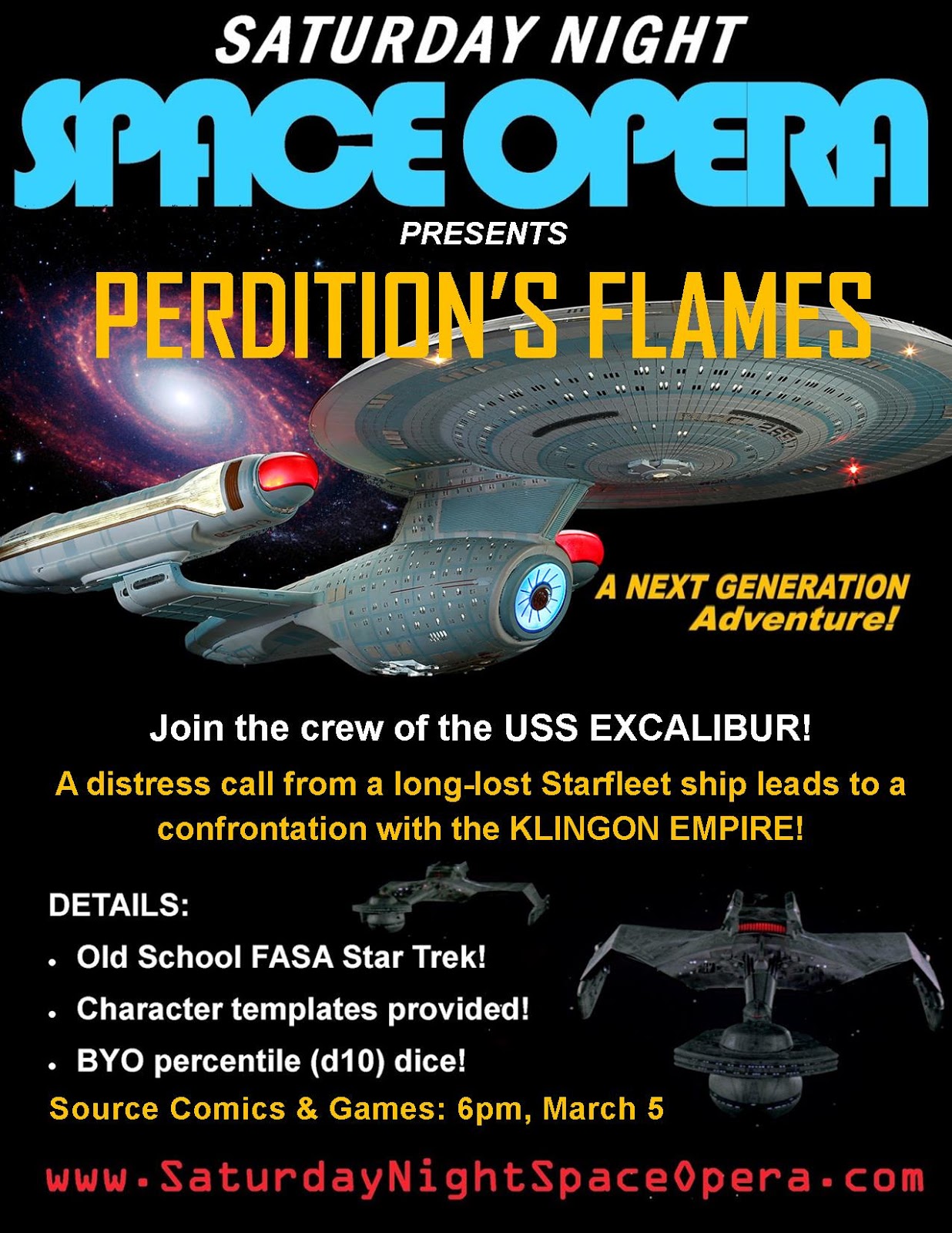
Saturday Night Space Opera: FASA Trek!


Our next Saturday Night Space Opera event is on Saturday, March 5 at 6 PM, at the Source Comics & Games in Roseville. Erik Mornes will again be the GM. His game a few months ago was great; it was also my first opportunity ever to play FASA Trek, even though I've been collecting the game since the 80s.

We'll look forward to seeing some of you Saturday night for the next adventure on board the Excalibur!

Thursday, February 11, 2016

Tomorrow's Fate Strange Stars Game


You start in a backwater star cluster connected to the iceworld Boreas. The star system’s name comes from its primary planet, Zolymayas. The system has that one inhabited planet; it’s a very hostile world with a crappy, third-rate starport. The planet is almost self-sustaining. Most technology here is late 19th Century, although as usual a few hoarders and exclusive enclaves have something better. Some places have electricity, and many have intact lead piping, but there’s no free Metascape access here.

You’re in a band. You came here for a gig at a spaceport dive called The Furry Octopus. All of 5 spacers showed up for that show. Nobody seemed very impressed. The space hauler who promised you a ride back to Boreas and out of this cluster took off early. So you’ve been stuck here a while. Turns out there’s less demand for cutting edge psychedelia than you were promised. Times are tough. You could really use a gig.

You’ll create characters using the Strange Stars Fate rules. Possible player character roles in the band include:
  • Promoter
  • Lead Singer
  • Musician(s) – feel free to invent an instrument
  • Groupie
  • Drug Supplier
  • Security/Roadies
  • Your own crazy ideas
You’ll also need a name for this band. You’ll have to duke that out at the table.

Saturday, January 30, 2016

A Different Light


My fourth book for Vintage Science Fiction Month is Elizabeth A. Lynn's A Different Light. It was published in 1978, so Lynn's novel just squeeks in under the Little Red Reviewer's definition of "vintage" as 1979. I don't like to think of my senior year in high school as the threshold, but there you go.

A lot of important things happened in '79, including the Sandinista and Iranian Revolutions. That year was the beginning of the end of a revolutionary cycle: the great wave that began with the Great Spring Victory in Vietnam, and ended with the unfortunate stalemates of El Salvador and Guatemala.

In one sense it's easy to see Lynn's novel as part of that wave. It was a late '70s mainstream SF novel with perfectly "out" and untroubled LGBTQ individuals. Not to mention "polycules" all over the place!

Queer space!

Those weren't easy times to be "out" as an LGBTQ author or to write SF with "out" characters. After all these years, I still remember the derision that an Ares reviewer brought to the back cover blurb for Lynn's Watchtower: "An Adventure Story for Feminists and Humanists." I went right out and bought that book! No regrets!

So what was the back cover blurb for A Different Light?

"Jimson had twenty years to live. Or one."

Jimson is a young adult on a backwater world. He's a successful artist, rather than a farmboy, but one might think he's a bit of a whiney Luke. Jimson's unhappy because he feels stuck on the planet New Terrain. He has a genetic disease which is treatable there (and really on any civilized world or space station) but which will explode into uncontrollable mutations if he goes into the Hype (i.e., hyperspace).

So that's bad.

I actually had to check myself on the perception that he's whiney. That perception is a form of biological/health-based privilege. Ableism if you like. Jimson has a right to feel stuck and whiney.

And Jimson has another reason to be unhappy too. His first lover, Russell, took off a number of years ago for space.  Russell didn't stay in touch, either. Jimson has a double loss going on.

So of course, Jimson is going to go off into the Hype to look for Russell.

Jimson hangs out in a spaceport and soon meets Leiko, a female spacer who becomes his lover. He makes art and hangs out in a spacer bar. Jimson makes friends with a number of other spacers.

It's worth a short digression to point out that Lynn's spacers have a culture apart from others in society. They have their own social rules, such as no questions. Spacers offer information about themselves to others only after a greater sense of intimacy/affinity/trust has been established. So we have the social anonymity of the big city/port city; the social nexus for the emerence of LGBTQ cultures. Here you can see traces of the lineage that began with Samuel R. Delany's working-class spacer/outsiders - and presumed sexual outlaws (1) - from Babel-17 and Nova. This lineage passes through Lynn's work and eventually leads to the protagonists in Melissa Scott's novels.

Jimson and Russell reunite. They have an adventure together. Jimson, star captain Russell, and his two hired crew go off to plunder religious artifacts from a primitive planetbound tribe (2). They are classic space assholes worthy to be PCs in virtually any Traveller RPG campaign.

Other things happen.

Jimson's cancer mutates with a vengeance. There's no magic cure, but the novel has a very interesting, open ending.

Something important occurred to me after I finished reading the novel. Just a few years after the publication of A Different Light, I had a significant life-changing experience that gave me something in common with Jimson. I met my first lover, and all too soon, he simply went off into space too. The silence became unbearable. I felt alone for a very long time - for years, in fact.

Thank god for my comrades in the Central America solidarity movement of those days; only a few really knew how how to support a gay comrade in the early '80s, but they helped me live in different ways and experience things greater than myself; things worth living for.

They helped me see a different light.

Notes:

(1) See the sexual outlaw aka gay ubermench in John Rechy's City of Night.  Delany more or less lived/endorsed the practice without embracing the ideology.

(2) I'm reasonably confident that Iain M. Banks lifted and twisted this scene Banks-style for Consider Phlebas.

Friday, January 29, 2016

Medieval Midwestern


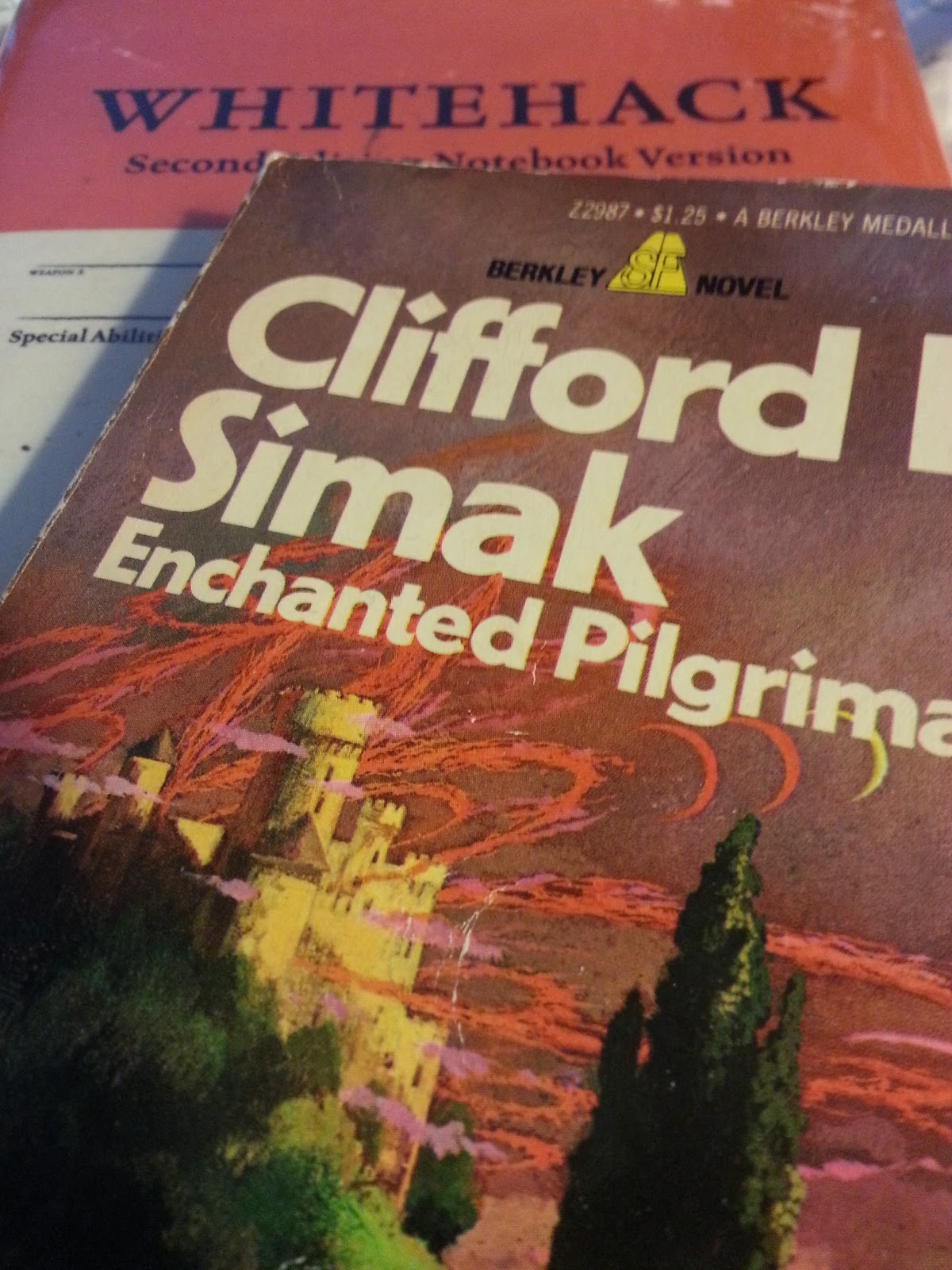
The third book that I read for Vintage Science Fiction Month was Clifford D. Simak's Enchanted Pilgrimage (1975). This novel is technically SF, since it features UFOs (wheels of flame right out of the Book of Ezekiel) and a baby robot. However, it has the feel and structure of a traditional fantasy quest novel. A scholar from Wyalusing University discovers an ancient manuscript hidden within the binding of another book. His discovery becomes known, which triggers the murderous jealously of a churchman. The hero flees toward the Wasteland to the west. On his journey new companions gather and a fellowship forms between the protagonist, a rafter goblin from the university library, a woodsman and his intelligent raccoon companion, a gnome, a girl (from the Wasteland) and a swamp-rafter.

Now the Wyalusing University reference is a giveaway. That place-name refers to the county of southwestern Wisconsin that was so beloved by Simak. Way Station was also set there, and I am sure some of his other novels feature this landscape as well. The pastoral themes Simak is known for come out in this novel. Most of the action is travelling across a landscape. I believe the Wastelands through which the PCs - I mean, characters, travel include the prairies of Minnesota and South Dakota, and I'm sure that the "Misty Mountains" where the novel ends are in fact the Black Hills.

So what is this world? Is it a post-apocalyptic setting? A late-medieval (1975) Christian alternate history North America with Neanderthals but without Indians? (And where have we seen that kind of thing before - and quite recently?)  All the characters tell us is that there are at least three parallel Earths: the one we know (and there is a motorcycle riding, gun shooting "action scholar" who comes from our world; the one shown in this story with its mix of humans, fey creatures, UFOs and robots; and one with signifiantly more magic, from which one of the character's parents hail.

There is one additional clue that the world of the story ties in to Simak's City.  There is a shabby Odin-like character called the Gossiper, who is accompanied by a shabby, moulting raven and a little dog with spectacles.

It was a fun read, and has inspired me to create a Medieval Midwestern campaign setting using Whitehack. Rest assured though that Native people aren't missing from my game.
 

Wednesday, January 27, 2016

Gone To The Dogs


My second book for Vintage Science Fiction Month was Clifford D. Simak's City. The novel is what John Clute's Encyclopedia of Science Fiction calls a fixup: a set of linked stories assembled into novel form (1). City was first published in 1952, but some of the stories collected in the novel go back as far as 1944.

The novel tells the future history of humans, dogs, robots, and mutants over thousands of years. Lots of people talk transhumanism. Let's face it: transhumanism is mostly just talky-talk. I mean monkey-talk.

But unlike the work of Cordwainer Smith, where for the most part in spite of transhumanist trappings people mostly don't change, in Simak's City, people really do change.

In fact, humans mostly just go away - most of them in a profoundly transhumanist way. Just read the short story "Desertion". It was very meaningful to rediscover this story of a man and his dog on Jupiter, and the union they achieve. I read this short story in an English class short story anthology, and along with Ray Bradbury's "All Summer in a Day", it has haunted me until now. The former is joyful but bittersweet. The latter is just so sad.

We see the rise of the mutants, and man's uplift of dogs - and the "handy" robot companions that man devises for dogs. We see robots: dutiful, wild, self-directed, lonely. We see several kinds of diaspora, including interstellar and multiplanar.

Has the book aged well? In terms of its vision of the future, I'd say it is a transhumanism unsurpassed; ironically, it's also a transhumanism that is rather embodied, and that keeps its feet on the ground. The novel does not pass the Bechdel Test, although Simak's characterization of women gets better in later novels.

(1) Closer to home here in Minnesota, Eleanor Arnason is also very good at writing collections of linked stories. See her Big Mama Stories and Hidden Folk: Icelandic Fantasies for examples (2).
(2) Huldufolk is worth looking up.


Sunday, January 10, 2016

SNSO! Strange Stars!


Last night was my first time running a Saturday Night Space Opera! event for our open group of players! I had eight players show up for my Fate Strange Stars game, which ran from 6 PM-10:15 or so at the Fantasy Flight Games Event Center.

We started with character generation, and that went pretty smoothly. I gave everyone a copy of the Strange Stars setting book, and copies of chapters Ch. 2 and 3 of the Strange Stars Fate Rule Book, which cover character generation and clades (races), respectively.

Jay's PC, and improvised Fate points!

The characters were:
  • Shrike, a space-ninja. Shrike stands for Synthetic Humanoid Reactionary Intelligent Killing Engine. Shrike was a true human in a "robot suit." His goal was never to give up the game that he was not a machine. One of his aspects was a stock phrase: "I am NOT a human being!" 
  • Dorchah, a Blesh (a crystalline insect with the downloaded memories of a human medic) with telekinetic abilities. This was the first time the player, Deanna, had played a tabletop RPG, although she is a World of Warcraft guildmaster! By the time of the climactic battle, she had really grown into her role as a combat medic, telekinetically putting respirator masks on the crew to protect them from nanites, and brewing up combat drugs to juice up the Hyehoon PC!
  • Butkowski, a burly, ornery Smaragdine engineer. We're pretty sure Butkowski couldn't be his real name, but he was so touchy that his crewmates didn't want to push on this issue. In the climactic battle with a Van Vogtian Coeurl in a cargo elevator, Engineer Butkowski pulled a trick on the energy starved beast!
  • Bhat Akana, a Voidglider. His name comes from the Hindi word meaning "Wonder." A bit before the climactic battle, Bhat Akana used his Voidglider senses, which include "hearing" way into the EM range, to determine that Shrike was most definitely not a robot! This was a very clever use of Voidglider base abilities skills.
  • Tcar, one of the feathered but flightless avian uplifts of the Hyehoon clade! Looking at Eric's character sheet after the game, I noticed he dropped in a Star Trek reference, listing Tchar's homeworld as Skorr! Tchar was the ship's pilot, but used his claws to great effect in the battle with the Coerul!
  • Taan, was a unique Moravec created by the most experienced Fate player. Taan is roughly humanoid, with three Waldo-like arms. Taan specialized in Creating Advantages during the combat, distracting the Coerul with the hypnotic gyrations of his three robotic arms, and in the last moments of the battle leaped onto the Coerul's back to distract it further.
  • Arkadina, an extremely chipper and talkative member of the angelic Deva clade. She felt truly called to battle against the Coerul, seeing it as her opposite: a demon from the darkest depths of hyperspace, and a grave existential threat to her god. She landed many blows against the monster, and even managed to slice off one of the tentacles emerging from the beast's back!
  • Aasimar, an androgenous Yantran technoshaman. She was committed to nonviolent diplomacy - even in the midst of battle, and Created Advantage against the Coerul by going into a trance and beginning a compassionate death trance for the beast. Every time Aasimar used her powers, her gender affect switched; the player created the gender pronoun indicator below (a tiny table tent) so that the changes were visible to the other players.

Fate is opimized for a group of 3-5 players and a GM. I've run Fate of Tekumel games with eight players, and that worked OK, but eight is really a big table to manage for a fast and furious Strange Stars game!

Here are a few things to make a big game like this go smoothly:
  • Bring enough Fate point chips for everyone - OR, be ready to improvise with little pieces of paper. I seriously underestimated how many players we would have! Fortunately, Jay Mac Bride had brought along some colored index cards. People made their own Fate points using the cards, and I folded cards in half to create little one-use Boost table tent indicators.
  • When big groups get excited, everyone is talking at once, and less extroverted players, who may have good ideas, can get frustrated. Enforce a more structured flow of play, rotating the action from player to player either clockwise or counter clockwise. I did this at the mid-game break at one player's suggestion. It made a real difference at the table. If memory services, this  procedure was part of the normal sequence of play with Diaspora too.
  • Table tents with character names are critical. 
  • I also create a GM map of players around the table, like the one below.

  • Finally, I use a Leuchturm 1917 journal for all my notes - work, reading groups, and game prep - and in-game jottings. I use Bullet Journal notation wherever possible or to-do lists and record keeping. It really helps to have everything in one place, with a quick method for notes.

The players were very engaged, had high energy, great ideas, and pushed the action forward at a breakneck pace. It was a great game to GM on the coldest night of the winter.