Showing posts with label Community Project. Show all posts

Monday, February 27, 2017

From The Zones: A New Field Report!


From the Zones is a community project curated here at Fate SF. It is a way of honoring and celebrating the Soviet SF novel Roadside Picnic by Boris and Arkady Strugatsky, as well as the film based on the novel, Andrei Tarkovsky's STALKER.

To see previous Field Reports from the Zones, visit here.

For information on how to participate in From the Zones, as well as resources, visit here.

To get inspired, check out Hereticwerks' new Field Report, Images From An Abandoned Camera (2), a perfect example of how Zones can be deadly and unpredictable, where seemingly everyday phenomena can have quite startling effects.


From the Zones logos courtesy of Hereticwerks. If you like them, check out their Zazzle store for other neat things!

Wednesday, March 2, 2016

Thirty Days Of Space 1889


For the April 2  Saturday Night Space Opera game, I'll be running the Ubiquity system version of the Space 1889 RPG.  I actually ran a Ubiquity-based Space 1889 game once before at a convention. I had to use the Ubiquity-based Leagues of Adventure RPG for that event, due to issues with the Kickstarter for the new game. Players had a lot of fun with that convention game, and I am sure that running Space 1889 with the official Space 1889 Ubiquity rules is going to go just fine.

Over the next 30 days or so, I am planning to write a series of posts on the RPG and game world as I prepare the scenario. This will be partly reflections based on reading the book, and partly exploration of themes related to the setting.

This version of the Space 1889 setting was written by Europeans, and there are subtle changes which are intriguing to me, such as the existance of a revolutionary government in France due to the victorious Paris Commune. That detail alone is pretty cool, and creates all sorts of possibilities for "Agents of the Commune" style international, interplanetary, and even anti-colonial intrigue.

Hopefully I'll get some reading done on the Commune this month. I have two classic histories of the Commune sitting on shelves less than five feet away from me, just waiting to be read.

Tuesday, March 1, 2016

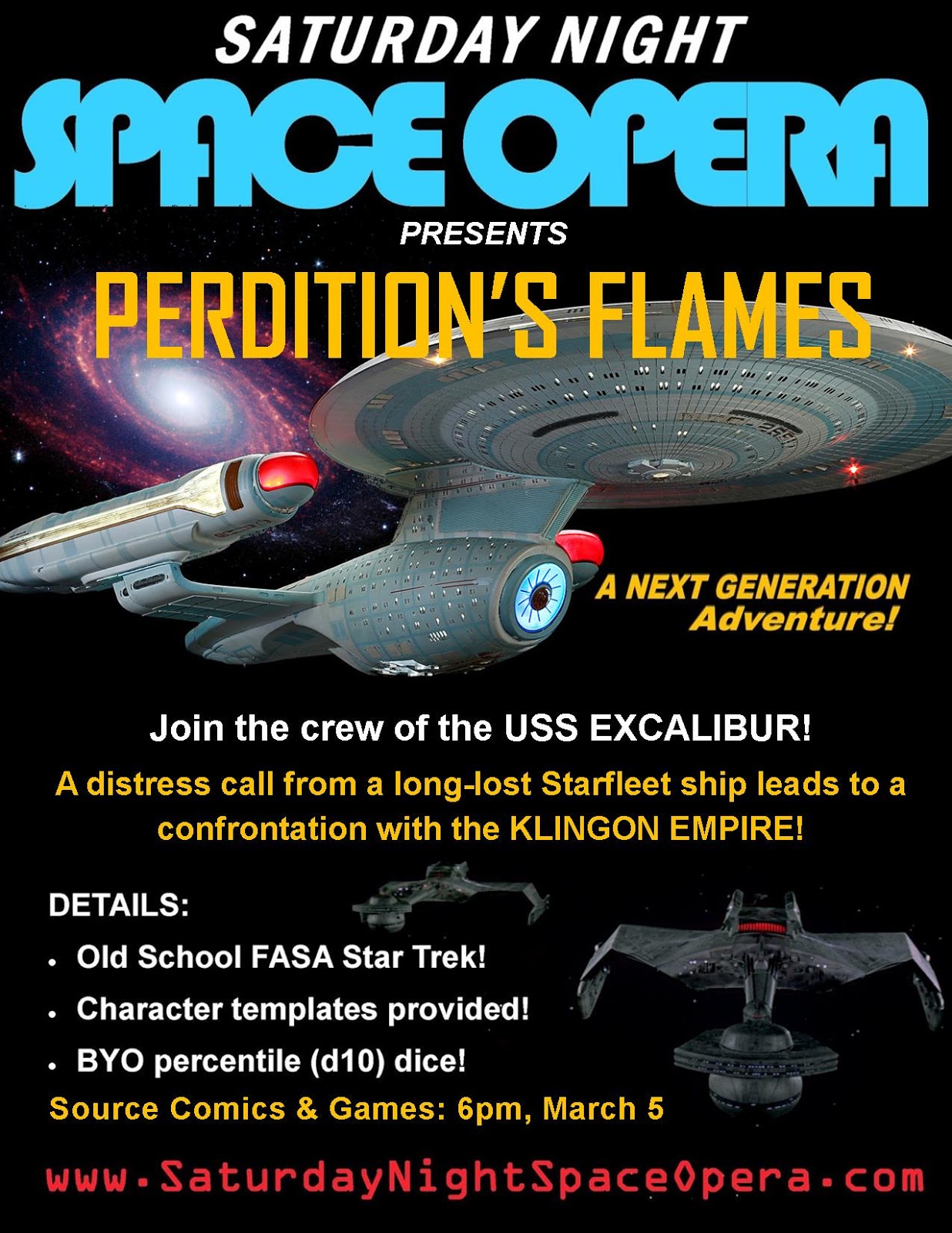
Saturday Night Space Opera: FASA Trek!


Our next Saturday Night Space Opera event is on Saturday, March 5 at 6 PM, at the Source Comics & Games in Roseville. Erik Mornes will again be the GM. His game a few months ago was great; it was also my first opportunity ever to play FASA Trek, even though I've been collecting the game since the 80s.

We'll look forward to seeing some of you Saturday night for the next adventure on board the Excalibur!

Saturday, January 30, 2016

A Different Light


My fourth book for Vintage Science Fiction Month is Elizabeth A. Lynn's A Different Light. It was published in 1978, so Lynn's novel just squeeks in under the Little Red Reviewer's definition of "vintage" as 1979. I don't like to think of my senior year in high school as the threshold, but there you go.

A lot of important things happened in '79, including the Sandinista and Iranian Revolutions. That year was the beginning of the end of a revolutionary cycle: the great wave that began with the Great Spring Victory in Vietnam, and ended with the unfortunate stalemates of El Salvador and Guatemala.

In one sense it's easy to see Lynn's novel as part of that wave. It was a late '70s mainstream SF novel with perfectly "out" and untroubled LGBTQ individuals. Not to mention "polycules" all over the place!

Queer space!

Those weren't easy times to be "out" as an LGBTQ author or to write SF with "out" characters. After all these years, I still remember the derision that an Ares reviewer brought to the back cover blurb for Lynn's Watchtower: "An Adventure Story for Feminists and Humanists." I went right out and bought that book! No regrets!

So what was the back cover blurb for A Different Light?

"Jimson had twenty years to live. Or one."

Jimson is a young adult on a backwater world. He's a successful artist, rather than a farmboy, but one might think he's a bit of a whiney Luke. Jimson's unhappy because he feels stuck on the planet New Terrain. He has a genetic disease which is treatable there (and really on any civilized world or space station) but which will explode into uncontrollable mutations if he goes into the Hype (i.e., hyperspace).

So that's bad.

I actually had to check myself on the perception that he's whiney. That perception is a form of biological/health-based privilege. Ableism if you like. Jimson has a right to feel stuck and whiney.

And Jimson has another reason to be unhappy too. His first lover, Russell, took off a number of years ago for space.  Russell didn't stay in touch, either. Jimson has a double loss going on.

So of course, Jimson is going to go off into the Hype to look for Russell.

Jimson hangs out in a spaceport and soon meets Leiko, a female spacer who becomes his lover. He makes art and hangs out in a spacer bar. Jimson makes friends with a number of other spacers.

It's worth a short digression to point out that Lynn's spacers have a culture apart from others in society. They have their own social rules, such as no questions. Spacers offer information about themselves to others only after a greater sense of intimacy/affinity/trust has been established. So we have the social anonymity of the big city/port city; the social nexus for the emerence of LGBTQ cultures. Here you can see traces of the lineage that began with Samuel R. Delany's working-class spacer/outsiders - and presumed sexual outlaws (1) - from Babel-17 and Nova. This lineage passes through Lynn's work and eventually leads to the protagonists in Melissa Scott's novels.

Jimson and Russell reunite. They have an adventure together. Jimson, star captain Russell, and his two hired crew go off to plunder religious artifacts from a primitive planetbound tribe (2). They are classic space assholes worthy to be PCs in virtually any Traveller RPG campaign.

Other things happen.

Jimson's cancer mutates with a vengeance. There's no magic cure, but the novel has a very interesting, open ending.

Something important occurred to me after I finished reading the novel. Just a few years after the publication of A Different Light, I had a significant life-changing experience that gave me something in common with Jimson. I met my first lover, and all too soon, he simply went off into space too. The silence became unbearable. I felt alone for a very long time - for years, in fact.

Thank god for my comrades in the Central America solidarity movement of those days; only a few really knew how how to support a gay comrade in the early '80s, but they helped me live in different ways and experience things greater than myself; things worth living for.

They helped me see a different light.

Notes:

(1) See the sexual outlaw aka gay ubermench in John Rechy's City of Night.  Delany more or less lived/endorsed the practice without embracing the ideology.

(2) I'm reasonably confident that Iain M. Banks lifted and twisted this scene Banks-style for Consider Phlebas.

Friday, January 29, 2016

Medieval Midwestern


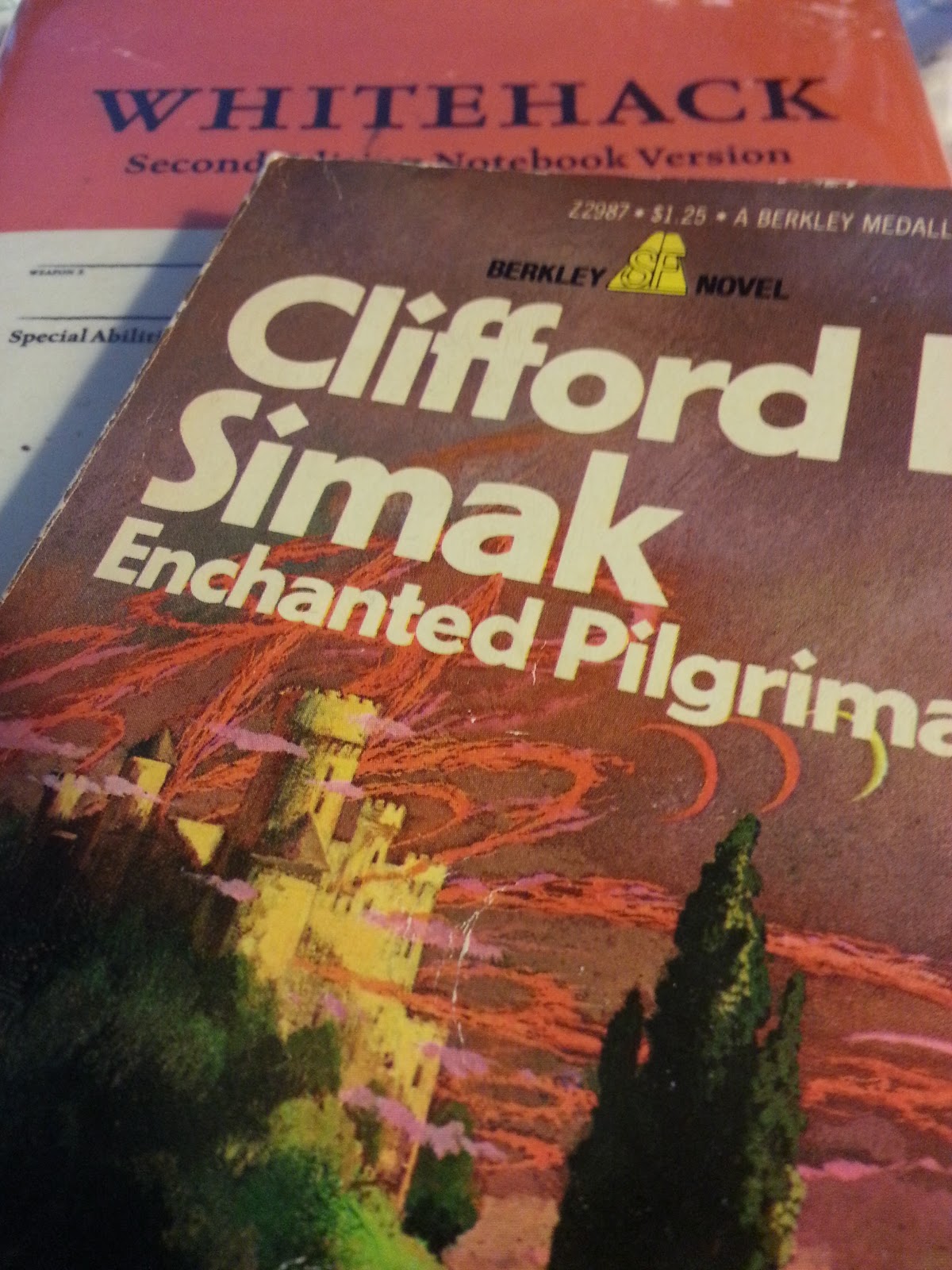
The third book that I read for Vintage Science Fiction Month was Clifford D. Simak's Enchanted Pilgrimage (1975). This novel is technically SF, since it features UFOs (wheels of flame right out of the Book of Ezekiel) and a baby robot. However, it has the feel and structure of a traditional fantasy quest novel. A scholar from Wyalusing University discovers an ancient manuscript hidden within the binding of another book. His discovery becomes known, which triggers the murderous jealously of a churchman. The hero flees toward the Wasteland to the west. On his journey new companions gather and a fellowship forms between the protagonist, a rafter goblin from the university library, a woodsman and his intelligent raccoon companion, a gnome, a girl (from the Wasteland) and a swamp-rafter.

Now the Wyalusing University reference is a giveaway. That place-name refers to the county of southwestern Wisconsin that was so beloved by Simak. Way Station was also set there, and I am sure some of his other novels feature this landscape as well. The pastoral themes Simak is known for come out in this novel. Most of the action is travelling across a landscape. I believe the Wastelands through which the PCs - I mean, characters, travel include the prairies of Minnesota and South Dakota, and I'm sure that the "Misty Mountains" where the novel ends are in fact the Black Hills.

So what is this world? Is it a post-apocalyptic setting? A late-medieval (1975) Christian alternate history North America with Neanderthals but without Indians? (And where have we seen that kind of thing before - and quite recently?)  All the characters tell us is that there are at least three parallel Earths: the one we know (and there is a motorcycle riding, gun shooting "action scholar" who comes from our world; the one shown in this story with its mix of humans, fey creatures, UFOs and robots; and one with signifiantly more magic, from which one of the character's parents hail.

There is one additional clue that the world of the story ties in to Simak's City.  There is a shabby Odin-like character called the Gossiper, who is accompanied by a shabby, moulting raven and a little dog with spectacles.

It was a fun read, and has inspired me to create a Medieval Midwestern campaign setting using Whitehack. Rest assured though that Native people aren't missing from my game.
 

Wednesday, January 27, 2016

Gone To The Dogs


My second book for Vintage Science Fiction Month was Clifford D. Simak's City. The novel is what John Clute's Encyclopedia of Science Fiction calls a fixup: a set of linked stories assembled into novel form (1). City was first published in 1952, but some of the stories collected in the novel go back as far as 1944.

The novel tells the future history of humans, dogs, robots, and mutants over thousands of years. Lots of people talk transhumanism. Let's face it: transhumanism is mostly just talky-talk. I mean monkey-talk.

But unlike the work of Cordwainer Smith, where for the most part in spite of transhumanist trappings people mostly don't change, in Simak's City, people really do change.

In fact, humans mostly just go away - most of them in a profoundly transhumanist way. Just read the short story "Desertion". It was very meaningful to rediscover this story of a man and his dog on Jupiter, and the union they achieve. I read this short story in an English class short story anthology, and along with Ray Bradbury's "All Summer in a Day", it has haunted me until now. The former is joyful but bittersweet. The latter is just so sad.

We see the rise of the mutants, and man's uplift of dogs - and the "handy" robot companions that man devises for dogs. We see robots: dutiful, wild, self-directed, lonely. We see several kinds of diaspora, including interstellar and multiplanar.

Has the book aged well? In terms of its vision of the future, I'd say it is a transhumanism unsurpassed; ironically, it's also a transhumanism that is rather embodied, and that keeps its feet on the ground. The novel does not pass the Bechdel Test, although Simak's characterization of women gets better in later novels.

(1) Closer to home here in Minnesota, Eleanor Arnason is also very good at writing collections of linked stories. See her Big Mama Stories and Hidden Folk: Icelandic Fantasies for examples (2).
(2) Huldufolk is worth looking up.


Sunday, January 3, 2016

Something For Simak: Way Station (1963)

Illustration by Wood, with more here


January is Vintage Science Fiction Month, with "vintage" being arbitrarily defined as 1979 (or earlier), and my first completed book for the month is Clifford D. Simak's Way Station. I have also read over a hundred pages so far of the new Simak collection.

Simak is good. He's also a local, having grown up in Southwestern Wisconsin, and having been an editor of the Minneapolis Star Tribune. I am curious to know which Minnesota authors consider him an influence. I am tempted to think Eleanor Arnason would be one; I should probably ask her.

Like fellow Wisconsin author August Derleth, and New York's Arch Merrill, there is a strong element of the regional writer to Clifford Simak. In fact, all of the novel Way Station takes place in what appears to be a farm dwelling in rural Wisconsin. The book conveys a strong feeling of nature on farmland in close proximity to the eastern bluffs along the Mississippi River.

So it is all the more extraordinary that the novel deals so effectively with the themes of world (and galactic) peace from the point of view of a seemingly ordinary, if immortal and lonely, Wisconsinite.

The novel also deals with spirituality and mysticism a bit more than a contemporary SF fan might like, and I gather this is a recurrent theme in Simak's work. I rather enjoyed that element of the novel; it reminds me a bit of the work of Cordwainer Smith.

I'll continue reading Simak this month, because the Second Foundation Reading Group (the oldest continuous SF reading group in the Twin Cities) has chosen the works of Clifford D. Simak as its topic for our gathering on January 31, 2 PM, at Parkway Pizza in Minneapolis.

I'm also following through on something I set out to read for last year's Vintage Science Fiction Month: re-reading Frank Herbert's Dune.  Last year, I bought a new copy of Dune specifically for that purpose. Then I went on to read other things. I'm a few chapters into Dune now, so we'll try to see this one through even though it may take a bit more than a month.

But Simak is the priority for right now.

We're on to City next.

Wednesday, August 27, 2014

Empty

Art by Tom J. Manning

"Empties are two hand-sized discs always 29 centimetres apart. If one is moved, the other will also move to hold its position. No force can move the discs closer or further apart.There is nothing between them, so they can, for example, be located on opposite sides of a wall."  - Stalker RPG, p. 35

But sometimes the Empties have something inside them, such as a swirling gas which stays within the virtual canister formed by the two discs. These are known as Full Empties. While Empties are very common "finds" in a Zone, Stalkers can really strike it rich when they find a Full Empty.

Full Empties are rare.

Some have swirling colored gas inside; others, a liquid. They can also store something like grains or pellets. Still other Full Empties store discrete objects such as artifacts or creatures/phenomena found in the Zones, such as silver webs.

At least one Institute is studying the Empties to determine whether time "inside" an Empty passes at the same rate as everything outside one.

Are they Alien canteens? Food storage? Reliquaries? Fuel containers left behind as roadside trash after the Visit?

Perhaps they are bug jars for alien butterfly hunters.

Thursday, August 14, 2014

Recent Field Reports From the Zones


This is a week The Strange is everywhere. So I thought it would be timely to remind folks about From the Zones - an ongoing community project inspired by Arkady and Boris Strugatsky's classic SF novel Roadside Picnic - as well as by Andrei Tarkovsky's great film STALKER, which is itself based on the Strugatskys' novel.

Background on the project and how to participate can be found right here. The collection of Field Reports by contributors describing new Zones, taxonomic tables, new phenomena, artifacts, threats, and more can be found right here. We welcome new Field Reports at any time.

We've had a recent Field Report by Bruce Baugh! Meet Moira Tesla, and her Glass Pistol! Bruce uses the new Valiant RPG to stat out a Stalker and a picnic in the Valiant Universe. We're a big fan of Cosmic Patrol, which uses the same game system as Valiant Universe, so we may be meeting Moira on her home turf once the Valiant HC comes out!

And hot on the heels of Bruce's post is a new interstellar campaign seed by Mark Carroll, called The Picnic Basket. Mark's Field Report calls on the Cosmic Patrol for help! You're going to want to read the comments for this one, which riff on Vernor Vinge, Roadside Picnic's Golden Sphere, and Hellraiser's Lemarchand devices.


From the Zones logo courtesy of Hereticwerks.

Monday, February 3, 2014

Dollar Store Dungeons: False Beholder


Today's post is another contribution to the Dollar Store Dungeons community project, in which we are sharing ideas for what GMs can do with a $1.00 item from a dollar store.


False Beholders, also called Oculoids, are cyclopean blemmyoids. A gregarious other-planar species with excellent military skills, Oculoids are often hired as mercenaries in the incessant internecine conflicts on many backwater worlds. They enjoy the company of almost any humanoid race, and will be social with whomever's company they keep: eating, drinking, and carousing with their comrades-at-arms regardless of species.

Oculoids usually fill out the roles of musketeers, artillerists, and sharpshooters. Condottiere who can put up with their incessant babble and constant snacking will find the Oculoids make loyal and courageous troops. However, it is best to be forewarned: Oculoids will cheerfully natter-on about anything and everything, even in the midst a heated battle. This can be distracting, especially to combat casters.

False Beholders base their name on a two word combination. The first word incorporates part of the name, title, or attribute of a specific deity. The second word incorporates part or all of the name of a favored weapon. Oculoid name choices become particularly bizarre on worlds that have an extensive commercial armaments industry and a rich-brand culture. Naming examples include: Thora Godhammer, Horus Vickers, Hekate Broomhandle, and Sovereign MP43.  

The grognards say they can tell when an Oculoid is about to fire a weapon: the huge-eyed creatures instinctively blink just before they pull the trigger. But most importantly, they rarely miss. The Oculoids' single great eye gives them telescopic long-distance vision, and they are natural experts with all ranged weapons. Like their namesakes, the eye of each False Beholder is also capable of emitting a ray of some kind: laser beam, frost or fire, petrification, charm, etc. Because of this power, it is folly to close with them in melee combat (as with the swordsman in the photo above).

Hiring Oculoids comes with two hidden costs. The first hidden cost is due to the fact that the Oculoids' fat, stubby fingers are too clumsy for them to readily use most conventional firearms. False Beholders need firearms that are heavier, bulkier, and more robust than those used by most humanoid races. Sometimes, an Oculoid brings suitable weapons with them to their new employer. But other times, a condottiere will need to front the costs of custom manufacturing suitable weapons at the time of hire.

The Oculoids' other hidden cost is their insatiable appetite. While False Beholders never need to eat (they can sustain themselves indefinitely by feeding on other-planar energies), Oculoids want to eat. Constantly. The condottiere has a couple of different options here. One is to equip them with a feed bag, so that they may shovel food into their wide toothy maw at will. The other option is to assign them a feeder who can toss battlefield chum into their mouths during combat. A note for those with delicate sensibilities: the Oculoids talk while they eat, and chew with their mouth open.

A few final notes on Oculoid anatomy and physiology:
  • Oculoids have two small antennae; these are telepathic organs which allow them to communicate with their own kind and with other telepathic creatures;
  • They seem to understand humanoid concepts of gender well enough, but it is unclear whether the Oculoids have genders;
  • Their mode of reproduction (?) or manufacture (?) is entirely unknown;
  • They have no skeleton or organ systems; beneath their smooth green elastic hide there is nothing but a light green organic gelatin;
  • The antennae have commerical value and are sometimes harvested for wands or fetishes; and 
  • Their hide has commercial value, as a variety of unbreakable and elastic bladders can be made from it.

OGL MECHANICS


False Beholders
Oculoid Blemmyae (friendly)

ASPECTS:
  • High Concept: Gregarious other-planar mercenaries 
  • Trouble: Their constant babble can be distracting
  • Aspect: That's one huge eye!
  • Aspect: They're called "False Beholders" for a reason!
  • Aspect: An army marches on its stomach
SKILLS:
  • STR: +2
  • DEX: 0
  • CON: +1
  • INT: +2
  • WIS: +3
  • CHA: +1
STUNTS:
  • Sureshot: The Oculoids are masters of all ranged weapons and take +2 to their DEX when attacking with them.  
  • Eye Ray: Every Oculoid's eye has a ray-like ability which can be used to Attack, Defend, Create an Advantage, or Overcome an Obstacle. The ability will be keyed to a specific Skill; the roll used is the designated Skill +2
  • Scout from the Rear: Take +2 to WIS skill to Create an Advantage by observing the close-in details of a location or individual, even from several zones away. 
REFRESH: 3

STRESS: 
  • Physical: 3
  • Mental: 4


Friday, January 31, 2014

Thursday Night Punctuated Equilibrium


The Hereticwerks blog was the host for January's RPG Blog Carnival. The theme this month was Transitions, whether in games, campaigns, or gaming groups. My regular Twin Cities Thursday night group has experienced plenty of transitions in the past couple of years, and we are looking forward to a great new transition starting next week.

More on that in a bit.

Transitions in our gaming group tend to follow a sort of punctuated equilibrium: we'll play a short campaign or multisession scenario, followed by a number of one shots of various Indie RPGs and storygames.

Recent campaigns/scenarios have included:
  • Blade & Crown campaign run by Eric Gilbertson; this is the first B&C campaign I have played in that wasn't run by the game's designer, Rachel Kronick. I think she had as much fun as I did finally getting to play her own game. I played my Eric Stoltz-inspired assassin, Stabber, with great gusto in that campaign.
  • The Alwyn Campaign, an episodic campaign I ran using Fate Accelerated Edition. The setting was the future ruined Earth of the Babylon 5 universe. We could come back to this campaign at some point. It was fun researching locations in the Twin Cities, and then extrapolating how they would look as far future ruins.
  • A playtest of a scenario for my forthcoming Fate product series, Project Generations which will be published by Modiphius Productions. We used Starblazer Adventures for the playtest!
  • Rachel Kronick ran a playtest of a forthcoming scenario for Blade & Crown. I had a lot of fun running a callow, brutal young mage in that one!
  • A playtest of Fate of Tekumel (TM) scenario that I will be publishing professionally some time in the next year. This will be a Tekumel Foundation-licensed Approved for Tekumel product, with wonderful art by Juan Ochoa.
Interspersed between these scenarios/mini-campaigns were numerous one shot games using a plethora of different systems including:
  • OG, Robin Laws' caveman game. We did a few different one-shots of this game
  • Lost Days of Memories and Madness, which our group calls the "elf memory game"
  • The Quiet Yeara wonderful storygame involving mapping a community and what happens to it during its final year before the Frost Shepherds come.  
  • Monsterhearts, your friendly neighborhood angsty let's all play high school monsters RPG. 
  • Heirs to the Lost World, Chad Davidson's wonderful alternate history RPG with pirates, Mayans, Aztecs, and more in the 17th Century Caribbean.
  • Durance, Jason Morningstar's "Botany Bay in space" storygame.
There's probably several more one-shots that I am missing.

So where are we headed in 2014? 

Next up is a campaign of Night's Black Agents, Ken Hite's RPG of espionage and vampire conspiracies. It should be pretty cool, as the GM is running the game in Eastern Europe, where he worked in the Foreign Service. We'll be doing a test drive of this GUMSHOE system RPG next week, and the campaign-proper will launch as soon as we all recover from Con of the North, where we're collectively running numerous games, as the House of Indie Games! 

Whew!

Tuesday, January 14, 2014

Two Million Swallow Gale

Art by Michael Hague

Two Million Swallow Gale (Nature/Summoning, Cost, Per Scenario, Persistent, Requires "Summon Nature's Ally" and a Pact with one of the Beast Lords): This spell is used to increase the speed of a sailing ship, enabling EITHER its swift pursuit of a target, OR its escape from any pursuing vessel(s).

The caster must have a preexisting Pact with an appropriate Beast Lord, such as the Lady of Winged Things. The Beast Lord will honor the pact by sending two million swallows to pull a ship forward with the power of their wings. The ship will have a thousand tether strings attached to its forward areas, with two thousand swallows pulling on each string. The caster rolls their Charisma +2 in an Overcome an Obstacle action vs. the Dexterity of the opposing vessel. If the casting succeeds, the caster's vessel overcomes its target OR it escapes its pursuer.

***

A Note on Inspirations: This spell is inspired by a scene in The Story of Doctor Dolittle. We've added a little bit of Moorcockian flavor with the Pact and the Beast Lords. Finally, the title feels a tad Exalted to us! 


Monday, January 13, 2014

Dollar Store Dungeons: Doctor Dolittle

Cover of the edition we purchased

Welcome back for our latest post on Dollar Store Dungeons, a cross-blog project coordinated by the NJW Games blog. Dollar Store Dungeons is about exploring the inexpensive GM resources available through dollar stores. In late December 2013, Rachel Kronick and I set out to each purchase $10 of items at the same dollar store. We're following that up with posts about our purchases. Today, we're taking a look at a resource which surprised me at our local dollar store: books for a dollar.

One of the three books I purchased for a dollar was The Story of Doctor Dolittle, a story by Hugh Lofting. Lofting was Irish, and fought in Europe with the Irish Guard during World War I, before migrating to the United States. Like many of his generation, he experienced the brutality of the war, and didn't want to expose his children to all that. Instead, he wrote fanciful letters to his children; these were the basis for the Doctor Dolittle stories.

Now, the musical and other film treatments of the story might make the doctor from Puddleby-on-the-Marsh seem incredibly cheesy and impossible to work into a game. But as I was reading the novel, I was struck by a few things that make Doctor Dolittle gameable:
  • When exactly the story is happening is a little unclear (at least from the first novel in the series) but it could be readily placed in the Napoleonic or Victorian era, especially in a non-horror setting with fantastic or outlandish elements. 
    • Doctor Dolittle would fit-in well with Blue Devil Games' Passages, which you can download for free here
    • The Doctor would also work well in  a Victoriana campaign, especially if the horror aspects of the setting were dialed down. Things would really get interesting for the Doctor if he not only cared for animals, but also for Victoriana's beastmen!
    • I could even see a Doctor Dolittle in the Land of Oz campaign. 
    • Don't put Doctor Dolittle in Unhallowed Metropolis, though. That's just wrong.
  • Doctor Dolittle can "talk to the animals"; he speaks their languages. And animals can readily converse with him. His reputation spreads easily among animals. They often come calling-on the Doctor after hearing about him through various animal grapevines
  • Animals like to live and adventure with Doctor Dolittle. The Doctor calls some (but not all) of his animal companions pets, but there is little or no sense of the human "owning" the animal here. In fact, Doctor Dolittle has so many animals - and often dangerous ones - living around him that he gradually looses his (human) medical practice. People are particularly afraid of his African crocodile. Instead, he opens a veterinary practice. Doctor Dolittle is very good at veterinary medicine, since he can converse with animals and ask them what their symptoms are. He hears about their ailments "right from the horse's mouth" so to speak.
  • The Doctor (like another one we know) eschews violence. Doctor Dolittle never uses violence to solve problems. He figures out other solutions - or his animal allies do it for him.
  • The animals do a lot of problem-solving in the stories. Many of the Doctor's animal companions have well defined skill niches. You could easily run a "The Doctor and His Companions" style game featuring Doctor Dolittle and several of his animal friends.
  • He has a built-in reason to adventure: Doctor Dolittle cares little about money. He spends it all on the care of animals. If one animal companion weren't tracking his expenditures, the Doctor wouldn't even know when he is out of money. But when the Doctor is out of money, he needs to go out and adventure to get some! 
  • In a mystery involving animals, Doctor Dolittle could team-up with Sherlock Holmes! I can imagine the Doctor's affable character would clash considerably with Sherlock's abrasive personality. No doubt Dr. Watson would be a useful intermediary! 
  • If the Doctor goes to India, he might meet Mowgli and his animal friends. What would Doctor Dolittle make of the so-called "Law of the Jungle"? He might do away with it entirely!

P. Craig Russell's take on Kipling's Mowgli


So let's write-up Doctor Dolittle:

Hugh Lofting

Doctor Dolittle
The famous veterinarian of Puddleby-on-the-Marsh

ASPECTS:
  • High Concept: The bachelor physician who talks to the animals
  • Trouble: Always running out of money
  • Aspect: Caring for animals always comes first
  • Aspect: No use for violence
  • Aspect: Always surrounded by animals

APPROACHES:

  • Careful: +2
  • Clever: +3
  • Flashy: +2
  • Forceful: 0
  • Quick: +1
  • Sneaky: +1
STUNTS:
  • Ask the Patient: Take +2 to your Flashy Approach when Creating an Advantage by talking to an animal in order to diagnose its problem. 
  • A Little Help From His Friends: Once per session, the Doctor may ask for and receive the help of an animal or group of animals that he has recently befriended. If he has already helped them, the Doctor calls in this Stunt for free; if he has yet to help them, he takes on the Temporary Aspect I owe my friends a favor, and eventually repay the animal(s) kindness in some way.
  • Peaceable Kingdom: Because the Doctor speaks the languages of animals, and has a peaceable nature, even fierce predators behave nicely. Take +2 to Flashy Approach to Overcome and Obstacle by making friends with an animal.
REFRESH: 3


Tuesday, January 7, 2014

Dollar Store Dungeons: Other Doctors

Two planes for $1.00

These two aircraft came in a $1.00 pack from the local dollar store. One is obviously a SR-71 Blackbird (but not black), while the other is a modern stealth aircraft (we're not too sure whether it's supposed to be a stealth fighter or a stealth bomber). Both aircraft have emblems on the wings which resembles the shirt emblems you see on crew of the U.S.S. Enterprise, which has me thinking about a specific way to use these.


Other Doctors, or-


Who is Gary Seven?


First of all, Trey Causey clued me into this. Others have blogged about thisas well. It's the question at the center of the 1968 Star Trek episode Assignment: Earth

Who is Gary Seven? Is it true that he's a Timelord?* After all, he uses one of these:


And he has some kind of console (with an interstellar transporter, no less) inside of his TARDIS "office":


And who or what is Gary Seven's cat?


We're told she's actually a shapeshifting alien:


And as if that's not enough, Gary Seven has another companion - I mean, "secretary."


Timelord or not, the Federation is going to keep an eye on any alien who is running around on 20th Century Earth tampering with space-based nuclear weapons. However, due to World War Three, the Federation's own records about what technologies were deployed exactly when are probably a little bit fizzy, at best. An SR-71? Not anachronistic. But a stealth fighter/bomber? Only the Federation, with its hazy historical records, would deploy one on Earth in 1968.

Chances are, both these planes are actually small time travel/warp-capable vessels disguised as  U.S. military aircraft of the late 20th/early 21st Century. The Federation deployed two of them to keep an eye on backtime threats from Gary Seven, other Timelords, aliens, etc. What happened to these planes and their crews? Who were their crews, anyway? Did the Federation also deploy ground-based agents? Were there Federation safe houses in major U.S. cities? There are some stories here worth exploring...


*There have been some nasty online discussions - particularly in forums - about whether Gene Roddenberry cribbed this episode of Star Trek while watching an episode of Doctor Who in London. That's not our concern in this post. We're mining the similarities for gameable ideas; that's all. 


Sunday, January 5, 2014

From The Zones - A Project Milestone


"From the Zones" turned 21 this weekend. That is, the 20th and 21st contributions to this cross-blog (and cross G+) collaboration went live over the last few days. The two most recent Field Reports were from The City of Iron and Hereticwerks blogs. Both deal with some of the strange phenomena discovered in the Zones.

From the Zones is inspired by the classic Soviet SF novel "Roadside Picnic" by Arcady and Boris Strugatsky, and by Andrei Tarkovsky's STALKER, the film based on the movie. The Zones are places where an alien Visit occurred; the aliens left behind various things, life forms, garbage/waste - quite frankly no one is quite sure what these items are, but many of them are both deadly and inexplicable. Various militaries, paramilitaries, and police have set up Zones of Exclusion around the Zones.

The idea was to establish a cordon sanitaire around these alien-infected spaces, but the reality is that people called Stalkers keep on sneaking in the Zones to take things out. There is a market for the artifacts they recover. And some of the Stalkers may actually be addicted to the experience of stalking/infiltrating the Zone. It is subtle. It is still. It is capable of sudden, deadly movement. The place seems alive and aware of those who come to it.

The basic background on for From the Zones - along with guidelines for how to participate - are available right here. A table of all the contributions to date are right here. We have had reports from Zones in Calgary, the U.S.A., and Africa. Numerous subtle, enigmatic, and deadly phenomena have been identified. So much so that scientists have even established a taxonomic scheme to classify new findings.

New discoveries are being made all the time, and we are certain there is a great deal more to discover. You can make a contribution at any time.

"From the Zones" logo courtesy of Hereticwerks

Tuesday, December 31, 2013

Dollar Store Dungeons: Lamprey Centipede


The centipede pictured above was one of a number of bugs in a $1 package of Creatures purchased at the dollar store. Full details on the contents of the package are available on our sister blog, The Everwayan. 


The Lamprey Centipede 

One of the post-apocalyptic horrors found in The Alwyn Campaign, the Lamprey Centipede is a subterranean threat on the post-apocalyptic future Earth of Babylon 5. It is one of a number of horrific monsters that can be found while exploring ruins from the age before the Great Burn. Whether it is one of the atomic children of the Great Burn, or is simply something that escaped from a laboratory or zoo during that disaster is one of the many mysteries lost in time. Perhaps one of the learned souls in the great monasteries of the South knows the truth...

Lamprey Centipedes range in length from 2-3 meters. They live in underground caves and tunnels, emerging at night to hunt game. Favorite prey include deer and wild pigs, but humans are all too often on their menu. The centipedes often stalk along tunnels, sewers, and wells, infiltrating the cellars of human dwellings in search of an easy meal.

The most horrifying feature of the Lamprey Centipede is how it eats. It has a circular maw flanked by two huge pincers. When the centipede senses its prey, the pincers become coated with a white frothy a paralytic poison. The Lamprey Centipede will first try to paralyze its prey with the pincers. Then its circular mouth will project outward for up to two decimeters, and begin chewing its way into the body of its victim. Our PCs killed a Lamprey Centipede in the second episode of The Alwyn Campaign. They found an interesting signet ring in its guts, along with some human finger bones.

When attacking humans, the Lamprey Centipede goes in the hard way.  It prefers to bite through the sternum and then consume the victim's heart and lungs first. Once it has cleaned out the victim's chest cavity, it begins eating downward and consumes the soft and calorie-rich organs in the abdomen. Miraculously, the victim often remains in a semi-conscious state during part or all of this two course meal. It's a horrible last meal.

Chirurgeons and torturers will pay delvers top dollar when they return with samples of the Lamprey Centipede's venom. Its armored segments are also valuable; they can also be used to fashion lamellar armor. Its teeth are exceptionally strong and sharp, and can be mounted for use as the blades on a macuahuitl.


http://www.michtoy.com/item-MRN-AZT042-
Aztec_Eagle_Warrior_Defending_with_Macuahuitl.html


OGL MECHANICS


Lamprey Centipede
Giant centipedes (neutral)

ASPECTS:
  • High Concept: Mutant centipedes with a taste for human flesh
  • Trouble:  Fears light and fire  
  • Aspect: "Did you just see something?"
  • Aspect: Frothy poison fangs
  • Aspect: There's never just one
APPROACHES
  • Careful: +1
  • Clever: +1
  • Flashy: 0
  • Forceful: +2
  • Quick: +3
  • Sneaky: +2
STUNTS:
  • Bone Saw: The creature takes a +2 to its Forceful Attack when biting through leather/cloth armor or a victim's ribcage to get to the tasty soft meat.
  • Paralytic Fangs: When the creature Succeeds with Style on a Forceful Attack, it injects its victim with a paralytic venom. The victim gains the Aspect Paralyzed for the remainder of the Scene. The venom also does +2 stress per turn until an anti-venom or some other healing measure occurs. 
REFRESH: 3


Monday, December 30, 2013

There's A Centipede On My Dollar Store!


What can a GM buy for their games in a Dollar Store if they have ten bucks? My friend Rachel Kronick proposed we explore this question back when there wasn't snow on the ground in Minnesota (hint: no earlier than May 2013). It took a while for us to set up a time shopping expedition in which we would each spend $10 on gaming supplies, but we finally did that last weekend. The result will be a series of posts on our blogs about what we each purchased, and how we might use those items in our gaming.

We used a very specific methodology in shopping:
  • The goal was to purchase $10 items each, and to do multiple posts each featuring an item
  • We agreed on an NTE ("Not to Exceed" amount in managed care parlance) of $10 for each of us (excluding tax)
  • Anything in the store could be purchased, as long as the purchaser thought it had some utility at the gaming table
  • We would browse and make our selections independently of each other while in the store together, so that we did not influence each others' purchasing decisions 
Rachel did her first post today, which you can see here.

I will start individual item posts tomorrow, but we're starting today with the gallery of what we purchased for our $10:


Sure, we're being a little bit coy with such a blurry photo. We want you to come back! Ten items, ten posts. Come back tomorrow to see the mysterious reveal begin in earnest.

You can join this project too! Here's details.

Sunday, December 29, 2013

Obscure Simulations Roundup: Metamorphosis Alpha


Today's FATE SF post is our contribution to the Obscure Simulations Roundup, a community blog hop dedicated to forgotten or under-appreciated RPGs. As regular readers of FATE SF know, I have a forthcoming generation ship RPG of my own called Project Generations. So it shouldn't be a big surprise that my OSR post is an appreciation for Jim Ward's original generation ship SF RPG, Metamorphosis Alpha (TSR, 1976).


Metamorphosis Alpha isn't the most obscure or forgotten RPG. After all, it was the first SF RPG published. It's not even out-of-print. You can buy Metamorphosis Alpha in PDF here, or pick up a hard copy from Lulu here.

I'm writing about Metamorphosis Alpha today because it has a special place in my heart. It was one of the first RPGs I purchased, shortly after the first edition of Traveller and around the same time that I picked up Whitebox D&D.

Cover of the Dell edition of Heinlein's "Universe"

One of the first SF novels I read as a kid was Robert A. Heinlein's Orphans of the Sky. It was an SF novel about a population of humans and mutants (you can see the mutant Joe-Jim standing in the picture above) living on a slower-than-light interstellar generation ship many generations after the ship's launch. Over that time, successive generations had 1) forgotten that they were on a star ship, and 2) had lost the skills to pilot and maintain their vessel. They were essentially lost in space, facing eventual doom unless a group of heroes rediscovered that they were on a ship that had a destination in mind. A small band of humans and mutants - two communities usually at each others' throats - made this discovery and set about to bring things to right.


Generation ship stories often involve an epistemological break from ignorance, to (re)discovery, to setting things right. Such a discovery is common in SF stories but particularly important in traditional generation ship narratives. For example, you see it in the very title of the classic Star Trek episode about the generation ship Yonada"For the World is Hollow and I Have Touched The Sky".

While scientific and cosmological discoveries made by characters in the Cthulhu Mythos stories are ultimately disempowering, underscoring the futility of human effort and of irrelevance of the human scale, discoveries made in generation ship stories are ultimately liberating and empowering. People learn that the world is not what it seems, that it needs to be fixed or improved in some way, and that the means to fix the generation ship and set its course right are within the characters' reach - if they know where to look, and what to make of things! The characters may have to struggle or sacrifice, but their efforts aren't ultimately in vain. That's hopeful, and a call to responsibility.

http://en.wikipedia.org/wiki/File:The_Starlost_-_intro.jpg

Of course, my encounter with the generation ship in Orphans of the Sky was quickly followed by watching the early '70s SF generation ship TV series, The Starlost. Ed Bryant and Harlan Ellison wrote the screenplay (and a novel, "Phoenix Without Ashes") for this Canadian TV series, and Ellison quickly turned against his series very vocally, deriding laughable plots, implausible SF terms, and rotten dialogue.  In 2011, "Phoenix Without Ashes" was also published by IDW as a graphic novel.


Oh well.  I loved the show as a kid. The ship model was wonderful and there was some interesting tech on the ship, such as the the habitat hemispheres, the iris doors, the small cassettes and devices used to control access to different parts of the ship through the iris doors, the bounce tubes that helped people get around the non-habitat parts of the ship quickly, and of course the librarian AI.

Silent Running also comes to mind as a generation ship eco-narrative of the '70s - even if those ships weren't really going anywhere.

Silent Running (1972)

They also had cute maintenance and gardening droids. Every generation ship needs maintenance drones of some kind. Somebody needs to continue working and repairing things while the humans busy themselves with killing each other.

Silent Running

So anyway, back to Metamorphosis Alpha. It's an extremely simple system by contemporary standards, but it does the job. There are six Abilities, rolled randomly using 3d6: Radiation Resistance (pretty important, as the generation ship Warden in the default setting was damaged by a cloud of interstellar radiation and is still contaminated with radiation), Mental Resistance (defense against psionic mental attacks, as well as the intelligence skill that helps characters understand the ship's now ancient, mysterious, and often deadly tech), DexterityStrength, Leadership Potential (only pure humans can attract followers; human and animal mutants don't even get this Ability), and Constitution (determines how many d6 of hit dice you get, as well as your ability to survive poisoning). If after reading the Constitution bit you're saying "Hello, Carcossa" you should be, although in Metamorphosis Alpha you only roll the dice for hit points when you create your character - not every encounter.

If you are a pure human, you are pretty much done at this point. Take clothes and weapons typical of your community. If you are going to play a mutant human or mutant animal, you roll 1d4 to determine the number of physical mutations you get, and 1d4 for the number of mental mutations. You pick your mutations from the lists for each type. Then the GM gets to roll to determine randomly what physical and mental mutational defects you get; the GM rolls either once (if the player has 4 or less mutations) or twice (i.e., once on each list, if the PC has 5 or more mutations). Mutants get no equipment.

Then you are ready to play. The core mechanic is d20 based and there won't be huge surprises to people who have played other OSR d20 games.

The GM needs to have at least part of one level of the Warden detailed before play begins. This is good as it enables sandbox play, but there's nothing to stop the GM from detailing as much of the ship upfront as they'd like to do. Like building a dungeon, this is a game in itself.

The book tells you what the general details of each deck of the ship should be, as well as the kinds of technologies found on the ship, and their relative complexity; PCs roll their Mental Resistance vs. an item's complexity in order to figure out if their character knows what to do with it and can handle it without risk of injury. There's guidance to help the GM build mutated animals, plants, and humans, as well as guidance for robots and androids (i.e., chemical life - essentially, replicants).

There's no experience system, so (all things being equal) characters will keep the abilities that they have until death or the end of the campaign. I think that's good, as it keeps play focused on exploration and problem-solving, and not on monster hunting and treasure seeking as ends in themselves. All the treasure in the world won't do you a bit of good if your ship burns up in an alien sun, crashes into an uninhabitable planet, or runs out of gas between the stars.

Here's a few campaign ideas for Metamorphosis Alpha:

Metamorphosis Moonbase Alpha: The sudden departure of Earth's rogue moon caused a disaster at home, and a very long, strange trip for the inhabitants of Moonbase Alpha. The Alphans are used to sudden transitions. One moment, their moon is travelling along in the depths of interstellar space; a few days or weeks or months later, it is careening into another solar system entirely.

So imagine the Alphans' surprise when they receive an automated distress signal from a ship they are approaching. A signal in English. It's a vast ship. It's an Earth ship: the hull says: "Warden." Moonbase Alpha's computer (there is only one!) has no record of any such launch. Was the vessel launched after the moon ripped itself out of Earth orbit?

A ship this big could have many things of value on board: replacement technology, hydroponic supplies and seeds, medicines, astrogational records, news from Earth - many things. The ship is crawling with radiation. It's too risky to send more than one Eagle to investigate. The Commander calls for volunteers.

[The GM should secretly roll 1d6. That is how many days the Eagle crew will have to explore the Warden before the moon begins to accelerate away from the Warden forever.]

An Eagle from Space:1999

Return to Yonada: The  U.S.S. Enterprise is called back to the asteroid generation ship of Yonada. A civil war has broken out on the vessel, even as it has settled into a stable orbit around a habitable world. A restorationist cult called The Most Devoted to the Oracle have declared that it is heresy to leave Yonada. They have tapped into the central computer of the ancient space ark, and have appropriated the medical secrets of the Fabrini (the Yonadan's distant ancestors who built the ship), unleashing a mutogenic viral plague which has wreaked havoc on the People of Yonada. Worse still, the High Priestess of the People, Natira, has gone missing. She must be rescued, as Natira is the Yonadan leader with the greatest interest in helping the People of Yonada complete their ancestors' long journey to colonize a new world.

Play a native Yonadan loyal to Natira, or a Federation officer! Find Yonada's rightful ruler! Defeat the cult and its mutant menace!

Yonada

Ark of the Shunned Ones: A reconnaissance starship far beyond the borders of the Humanspace Empire discovers an ancient generation ship: a vessel of the hideous and inimical Shunned Ones. The Ship's Telepath reports the presence of human minds on-board the generation ship, as well as the minds of a great many other alien races. The Shunned Ones' ship is in a terrible state of disrepair, leaking radiation and strange other-planar energies; it may not survive much longer. It would be desirable to rescue the humans on-board, and to explore this great vessel before its imminent demise. The Captain orders a team of scientists and marines to board the ship.

Hideous Inimical Alien From "This Island Earth"

Beneath the Pyramid of the Sun: The great hexagonal Sun crosses the sky every day. Every day, your temple feeds it a live human heart, ensuring that it will return from the Underworld at the end of the night to bring the next day. Yet today, just before the sacrifice, a strange creature appeared from the Underworld beneath the temple, and stole the mid-day sacrifice. A group of brave warriors and priests must descend into the Underworld and find this monster.

"Chariots of the Gods?", anyone? Aztecs, mutants, and more on a generation ship with many different habitat compartments, each containing a different ancient human culture.  (Check out Harry Harrison's Captive Universe for even more inspiration!)

"Captive Universe" cover art by Alan Guttierez

Also, be sure to check out Brett Slocum's idea for a Paranoia-Metamorphosis Alpha mash-up over at The Eye of Joyful Sitting Amongst Friends blog.

Finally, we leave you with a rather evocative piece from near the end of the Metamorphosis Alpha book. The artist is David Sutherland, who was not only responsible for the art in Metamorphosis Alpha, but also did many of the illustrations for Empire of the Petal Throne.

Art by David Sutherland!