Showing posts with label Something For Simak. Show all posts

Friday, January 29, 2016

Medieval Midwestern


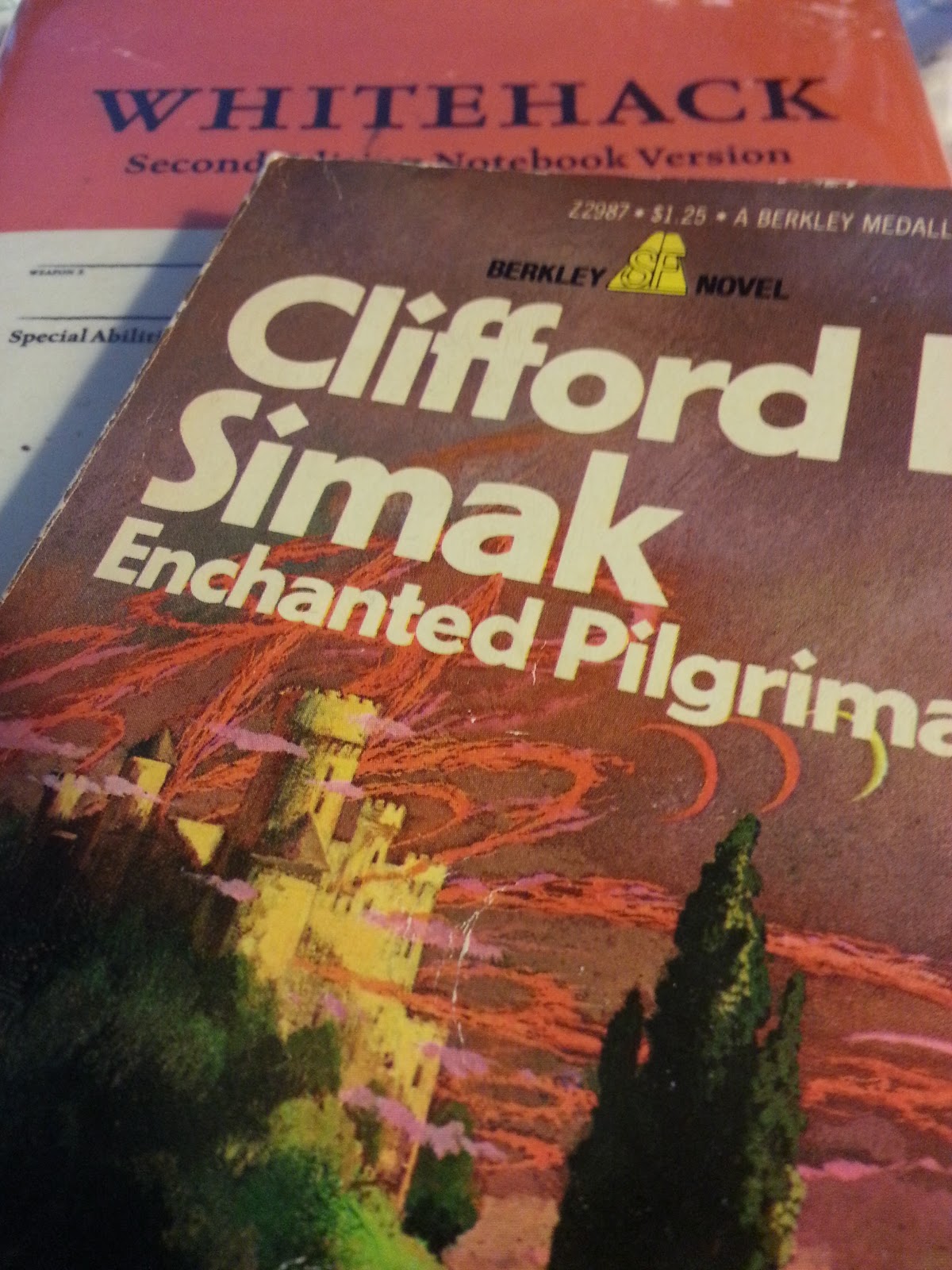
The third book that I read for Vintage Science Fiction Month was Clifford D. Simak's Enchanted Pilgrimage (1975). This novel is technically SF, since it features UFOs (wheels of flame right out of the Book of Ezekiel) and a baby robot. However, it has the feel and structure of a traditional fantasy quest novel. A scholar from Wyalusing University discovers an ancient manuscript hidden within the binding of another book. His discovery becomes known, which triggers the murderous jealously of a churchman. The hero flees toward the Wasteland to the west. On his journey new companions gather and a fellowship forms between the protagonist, a rafter goblin from the university library, a woodsman and his intelligent raccoon companion, a gnome, a girl (from the Wasteland) and a swamp-rafter.

Now the Wyalusing University reference is a giveaway. That place-name refers to the county of southwestern Wisconsin that was so beloved by Simak. Way Station was also set there, and I am sure some of his other novels feature this landscape as well. The pastoral themes Simak is known for come out in this novel. Most of the action is travelling across a landscape. I believe the Wastelands through which the PCs - I mean, characters, travel include the prairies of Minnesota and South Dakota, and I'm sure that the "Misty Mountains" where the novel ends are in fact the Black Hills.

So what is this world? Is it a post-apocalyptic setting? A late-medieval (1975) Christian alternate history North America with Neanderthals but without Indians? (And where have we seen that kind of thing before - and quite recently?)  All the characters tell us is that there are at least three parallel Earths: the one we know (and there is a motorcycle riding, gun shooting "action scholar" who comes from our world; the one shown in this story with its mix of humans, fey creatures, UFOs and robots; and one with signifiantly more magic, from which one of the character's parents hail.

There is one additional clue that the world of the story ties in to Simak's City.  There is a shabby Odin-like character called the Gossiper, who is accompanied by a shabby, moulting raven and a little dog with spectacles.

It was a fun read, and has inspired me to create a Medieval Midwestern campaign setting using Whitehack. Rest assured though that Native people aren't missing from my game.
 

Wednesday, January 27, 2016

Gone To The Dogs


My second book for Vintage Science Fiction Month was Clifford D. Simak's City. The novel is what John Clute's Encyclopedia of Science Fiction calls a fixup: a set of linked stories assembled into novel form (1). City was first published in 1952, but some of the stories collected in the novel go back as far as 1944.

The novel tells the future history of humans, dogs, robots, and mutants over thousands of years. Lots of people talk transhumanism. Let's face it: transhumanism is mostly just talky-talk. I mean monkey-talk.

But unlike the work of Cordwainer Smith, where for the most part in spite of transhumanist trappings people mostly don't change, in Simak's City, people really do change.

In fact, humans mostly just go away - most of them in a profoundly transhumanist way. Just read the short story "Desertion". It was very meaningful to rediscover this story of a man and his dog on Jupiter, and the union they achieve. I read this short story in an English class short story anthology, and along with Ray Bradbury's "All Summer in a Day", it has haunted me until now. The former is joyful but bittersweet. The latter is just so sad.

We see the rise of the mutants, and man's uplift of dogs - and the "handy" robot companions that man devises for dogs. We see robots: dutiful, wild, self-directed, lonely. We see several kinds of diaspora, including interstellar and multiplanar.

Has the book aged well? In terms of its vision of the future, I'd say it is a transhumanism unsurpassed; ironically, it's also a transhumanism that is rather embodied, and that keeps its feet on the ground. The novel does not pass the Bechdel Test, although Simak's characterization of women gets better in later novels.

(1) Closer to home here in Minnesota, Eleanor Arnason is also very good at writing collections of linked stories. See her Big Mama Stories and Hidden Folk: Icelandic Fantasies for examples (2).
(2) Huldufolk is worth looking up.


Monday, January 11, 2016

Reading And Remembering


Today I overheard two of the staff at Moon Palace Books talking about posting David Bowie's list of his top 100 books. I read a G+ post over lunch in which someone said that the best way to honor an artist is to do something creative. I thought what I could do today is start a list of my top 100 books. 

I'm only including ones that I've read cover-to-cover. So no Bible and no Dhalgren. Yet.

In no particular order or precedence, here's a few to get us going:
  1. Miguel Marmol by Roque Dalton. The autobiography of one of the founders of the Communist Party of El Salvador, interviewed by Roque Dalton, El Salvador's greatest poet, himself a martyr and exemplar of the next great revolutionary generation of the 1970s. If you only read one book on the '20's-30's, it should be this one. 
  2. The German Ideology by Karl Marx (particularly for the 11 Theses on Feuerbach; it is possible to skip the rest).
  3. Way Station by Clifford D. Simak.
  4. Horses Make A Landscape More Beautiful by Alice Walker. The first book of poetry I read.
  5. Poemas Clandestinas by Roque Dalton. Wrote poems that incited revolution.
  6. The Black Jacobins by C.L.R. James. Still the most important book about the Haitian Revolution.
  7. The Stars In My Pocket Like Grains of Sand by Samuel R. Delaney.
  8. The Once and Future King by T.H. White.
  9. Ring of Swords by Eleanor Arnason.
  10. The Corum Saga by Michael Moorcock.
  11. The Selfish Gene by Richard Dawkins. All the world's rubbish about memes started here, but that's not why this book is important.
  12. Philosophical Investigations by Ludwig Wittengenstein.
  13. The Violence of Abstraction by Derek Sayer
  14. Babel-17, Nova, Empire Star, The Ballad of Beta-2, the Fall of the Towers trilogy, and the Jewels of Aptor by Samuel R. Delaney. We'll leave a few lines for other people.
  15. Dune by Frank Herbert.
  16. The Gnostic Gospels by Elaine Pagels.
  17. The Consolation of Philosophy by Boethius. I have a feeling this list may end up more Plato than Marx, but the real reason this book is on the list is because I discovered a possible reference in Boethius' text to the Gnostic prayer-poem "Thunder, Perfect Mind."
  18. The Scar by China Mieville.
  19. Muhammad by Eliot Weinberger. A very short book of beautiful stories about the life of the Prophet, composed as an act of resistance on the eve of Bush's disastrous invasion of Iraq. I read a selection from it at the M.A.R. Barker memorial. 
  20. Night's Master & Death's Master by Tanith Lee.
  21. The Long War and Power in the Isthmus by James Dunkerley. Two important works on the political economy of Central America.
  22. The Elric saga by Michael Moorcock.
  23. The Anti-Social Family by Michele Barrett and Mary McIntosh, and Women's Oppression Today: Problems in Marxist Feminist Analysis by Michele Barrett. The first of these is the most important, and critiques the central role of family ideology in our politics, and how little it offers families, women, or anyone else.
  24. Saint Foucault: Towards a Gay Hagiography by David Halperin.
  25. History of Sexuality, Vol. 1 by Michel Foucault.
  26. Stone Butch Blues & Trangender Liberation: A Movement Whose Time Has Come by Leslie Feinberg. The former is a working class novel set in Buffalo, NY, and the latter is a chapbook published by World View Forum, the print house of Workers World Party.
  27. Multitude by Michael Hardt and Tony Negri.
  28. City by Clifford D. Simak.
  29. Lord of the Rings by J.R.R. Tolkien.
  30. The Tomoe Gozen saga by Jessica Amanda Salmonson.
  31. A Different Light by Elizabeth A. Lynn.

Sunday, January 3, 2016

Something For Simak: Way Station (1963)

Illustration by Wood, with more here


January is Vintage Science Fiction Month, with "vintage" being arbitrarily defined as 1979 (or earlier), and my first completed book for the month is Clifford D. Simak's Way Station. I have also read over a hundred pages so far of the new Simak collection.

Simak is good. He's also a local, having grown up in Southwestern Wisconsin, and having been an editor of the Minneapolis Star Tribune. I am curious to know which Minnesota authors consider him an influence. I am tempted to think Eleanor Arnason would be one; I should probably ask her.

Like fellow Wisconsin author August Derleth, and New York's Arch Merrill, there is a strong element of the regional writer to Clifford Simak. In fact, all of the novel Way Station takes place in what appears to be a farm dwelling in rural Wisconsin. The book conveys a strong feeling of nature on farmland in close proximity to the eastern bluffs along the Mississippi River.

So it is all the more extraordinary that the novel deals so effectively with the themes of world (and galactic) peace from the point of view of a seemingly ordinary, if immortal and lonely, Wisconsinite.

The novel also deals with spirituality and mysticism a bit more than a contemporary SF fan might like, and I gather this is a recurrent theme in Simak's work. I rather enjoyed that element of the novel; it reminds me a bit of the work of Cordwainer Smith.

I'll continue reading Simak this month, because the Second Foundation Reading Group (the oldest continuous SF reading group in the Twin Cities) has chosen the works of Clifford D. Simak as its topic for our gathering on January 31, 2 PM, at Parkway Pizza in Minneapolis.

I'm also following through on something I set out to read for last year's Vintage Science Fiction Month: re-reading Frank Herbert's Dune.  Last year, I bought a new copy of Dune specifically for that purpose. Then I went on to read other things. I'm a few chapters into Dune now, so we'll try to see this one through even though it may take a bit more than a month.

But Simak is the priority for right now.

We're on to City next.

Saturday, December 26, 2015

Strange Stars A-To-Z: "T" Is For Transmogs

Source

Transmogs were used by the earliest labor teams to leave Old Earth. These teams usually consisted of multiple robots and a single human team lead. Robots possessed artificial intelligence, often with quite pedestrian, companionable, crotchety, or quirky personalities. Having a human team lead was essential to these teams' success. Robot teams were more efficient, more cooperative, and more purposeful when accompanied by a human.

While the ancient robots displayed unique personalities, they were not highly specialized. Instead, these ancient machines used swappable skill modules called transmogs. These were small, thumb sized devices which snapped into a port in the robot's head. Need to switch spacehand skills for salesmen's skills? Swap out the transmog. Need a construction team rather than an ag-team? Look around in the box where all the transmogs are stored and swap the modules out.

If you're confused which transmogs are which, almost any robot on a labor team can help you find the right one.

A few of these robots still exist among the Strange Stars today. They are valuable collectors items, as they often know the locations of archaitech, the hyperspace routes to long-lost systems, and how to build and repair hyperdrives.

The key, of course, is to find one with the right transmogs to do the job - or someone who possesses some of these old modules but who doesn't know or have a use for them. Many transmogs end up being used as jewelry or charms by the ignorant...

This Strange Stars post was inspired by Clifford D. Simak's short story "Installment Plan".

***

We recently published some Quick and Dirty Robot Rules for Strange Stars. Transmogs can be used with these rules quite easily. Here's what to do:
  • In place of the Assignment aspect, give the robot a Personality aspect. Examples include:
    • Lazy labor robot
    • Battered and brused mechanical spacehand
    • Any crankier and you'd need to wind him
    •  Sexy but rusty gynoid
    • A machine that remembers ancient things
  • Select a Failure Mode. Particulary appropiate ones for ancient labor team robots include:
    • Touchy transmog slot
    • Needs direction
    • A tendency to wander
    • No spare parts
  • Select skills/approaches as normal.
  • Write in a Transmog Slot as an Extra. 
    • Instead of selecting three Stunts, each of these robots has a single transmog slot. 
    • When a transmog is plugged into the slot, the robot temporarily acquires one specific transmog stunt. 
    • Transmog stunts represent physical, mental, or social skills; they can never be psionic in nature. 
    • A robot may not swap out their current transmog on their own. The swap always requires the assistance of another character. It takes one turn to make the swap. 
    • There's no hard and fast limit on the number of transmogs that a robot has in their possession, but 5 is a good starting number.
    • If a player is creating a transmog-capable robot, they may start play as soon as they have written one transmog stunt for the character. Other transmog stunts may be selected during play.